
Introduction
AI has rapidly become a core part of modern hiring. Resume screening, candidate ranking, and even interview analysis are now routinely delegated to automated systems. The promise is compelling: faster hiring, reduced costs, and more objective decision-making.
But there’s a growing gap between that promise and reality.
A 2024 study from the University of Washington found that AI resume screening systems showed a striking bias: resumes with white-associated names were preferred 85% of the time, compared to just 9% for Black-associated names, across more than 500 job listings and millions of comparisons. That’s not a marginal issue—it’s systemic.
This challenges a common assumption: that AI removes human bias. In practice, AI often reflects and amplifies existing patterns embedded in historical data, job descriptions, and even language itself.
For HR leaders, recruiters, founders, and compliance teams, this creates a difficult tension. AI tools can dramatically improve efficiency—but they also introduce new legal, ethical, and reputational risks.
Screen every candidate against the same written criteria — free, no credit card.
In 2026, understanding AI hiring bias is no longer optional. It’s a requirement for responsible hiring.
This article breaks down how bias actually emerges in AI systems, what recent legal cases reveal, what regulations demand, and how companies can use AI screening tools more responsibly—without assuming they are bias-free.
How AI Hiring Bias Actually Happens
AI bias in recruitment is rarely intentional. It typically emerges from the interaction between data, models, and decision frameworks. Understanding these mechanisms is key to managing risk.
1. Biased Training Data
Most AI hiring tools are trained on historical hiring data or large language datasets. If past hiring decisions favored certain demographics—consciously or not—the model learns those patterns.
For example:
- If a company historically hired more men for engineering roles, the model may infer male-associated signals as “successful.”
- If leadership roles were predominantly held by candidates from certain schools or backgrounds, those signals become proxies for success.
The model doesn’t “know” it’s being biased. It simply optimizes based on patterns it sees.
2. Keyword Matching and Resume Signals
Many AI screeners rely heavily on keyword matching. This introduces subtle but significant bias:
- Candidates from underrepresented backgrounds may use different terminology.
- Career gaps (e.g., caregiving, disability-related breaks) may be penalized.
- Non-traditional career paths often score lower because they don’t match predefined patterns.
This is sometimes referred to as algorithmic bias in recruitment—where the structure of the system itself disadvantages certain groups.
3. Large Language Model (LLM) Bias
Modern AI screening tools increasingly use LLMs. These models are trained on vast internet data, which includes societal biases.
This can lead to:
- Associations between certain names and perceived competence
- Cultural or linguistic bias in how resumes are interpreted
- Overweighting of prestige signals (elite universities, well-known companies)
The University of Washington study highlights this clearly: even without explicit demographic data, name-based inference alone introduced significant bias.
4. Proxy Discrimination
Even when systems avoid explicit attributes like race, gender, or age, they often rely on proxies:
- Zip codes → socioeconomic status or race
- Graduation year → age
- University attended → class background
- Language patterns → cultural or regional identity
This is known as proxy discrimination, and it’s one of the hardest forms of bias to detect and mitigate.
5. Black-Box Decision Making
Many AI hiring tools operate as black boxes:
- No clear explanation of why a candidate was rejected
- No transparency into scoring criteria
- Limited ability to audit decisions
This lack of explainability makes it difficult to identify bias—and even harder to defend decisions in legal or regulatory contexts.
Recent Lawsuits and Enforcement
The legal landscape around AI hiring bias is evolving quickly. Several high-profile cases highlight the risks companies face when deploying AI in recruitment.
Mobley v. Workday, Inc.
One of the most closely watched cases is Mobley v. Workday, Inc., a class-action lawsuit alleging age discrimination through algorithmic screening.
- The plaintiff claims that automated systems disproportionately rejected older applicants.
- In May 2025, the court granted preliminary class certification, allowing the case to proceed on behalf of a broader group.
This case is significant because it targets not just the employer, but the software provider itself—raising questions about liability across the AI supply chain.
CVS and HireVue Settlement (July 2024)
CVS settled a lawsuit related to its use of HireVue’s AI video interview platform, which analyzed facial expressions and nonverbal cues.
Key concerns included:
- Lack of transparency in how candidates were evaluated
- Potential bias in interpreting facial expressions across different demographics
- Absence of informed consent
The case underscored a broader issue: biometric and behavioral AI systems carry heightened risk, especially when they attempt to infer personality or intent.
Intuit / HireVue EEOC Charges (March 2025)
In another case, a deaf Indigenous applicant filed charges with the EEOC alleging that an AI-powered interview system failed to provide adequate accommodations.
This highlights a critical compliance issue:
- AI systems must not only avoid discrimination
- They must also actively support accessibility and accommodation requirements
Failure to do so can violate disability laws—even if the bias is unintentional.
What These Cases Mean
Across these examples, a few patterns emerge:
- Liability is expanding: Vendors and employers may both be held accountable
- Transparency matters: Lack of explainability increases legal risk
- Accessibility is non-negotiable: AI systems must accommodate diverse needs
- “We didn’t intend bias” is not a defense
For organizations using AI screening tools, these cases are a clear signal: governance and oversight are essential.
Regulations You Need to Know
Governments are moving quickly to regulate AI in hiring. In 2026, several frameworks are already shaping how companies must operate.
NYC Local Law 144
New York City’s Local Law 144 is one of the first regulations specifically targeting AI in hiring.
It requires:
- Annual independent bias audits of automated employment decision tools
- Public disclosure of audit results
- Candidate notification when AI is used
This law directly addresses AI screening discrimination and sets a precedent for other jurisdictions.
California Regulations (Effective October 1, 2025)
California has introduced stricter rules:
- It is unlawful to use automated decision systems that discriminate against protected groups
- Companies must conduct bias testing
- Employers must maintain records for four years
These requirements significantly increase compliance obligations, especially for startups scaling quickly.
EU AI Act
The EU AI Act classifies recruitment systems as “high-risk” AI use cases.
This means:
- Mandatory risk assessments
- Strict documentation requirements
- Ongoing monitoring and auditing
- Transparency obligations toward candidates
For companies hiring in Europe—or hiring EU candidates remotely—this regulation applies.
Illinois Artificial Intelligence Video Interview Act (AIPA)
Illinois focuses specifically on AI-driven interviews:
- Requires candidate consent
- Limits how data can be used and shared
- Imposes retention and deletion requirements
The Bigger Picture
Across jurisdictions, a consistent trend is emerging:
- AI in hiring is treated as high-stakes decision-making
- Bias is not just an ethical issue—it’s a compliance issue
- Documentation, audits, and transparency are becoming mandatory
Companies can no longer treat AI hiring tools as “set and forget” solutions.
How to Use AI Screening Responsibly
AI can still be valuable in hiring—but only when used thoughtfully. Here are five principles for fair AI screening.
1. Keep Humans in the Loop
AI should assist, not replace, human judgment.
- Use AI to surface insights, not make final decisions
- Ensure recruiters review and contextualize results
- Provide override mechanisms
At CandidatePilot, AI generates structured evaluations with written explanations, but the human always makes the final call.
This is what it looks like in CandidatePilot. The ranking shows the reason behind each position, so a recruiter can check the call instead of trusting a number.
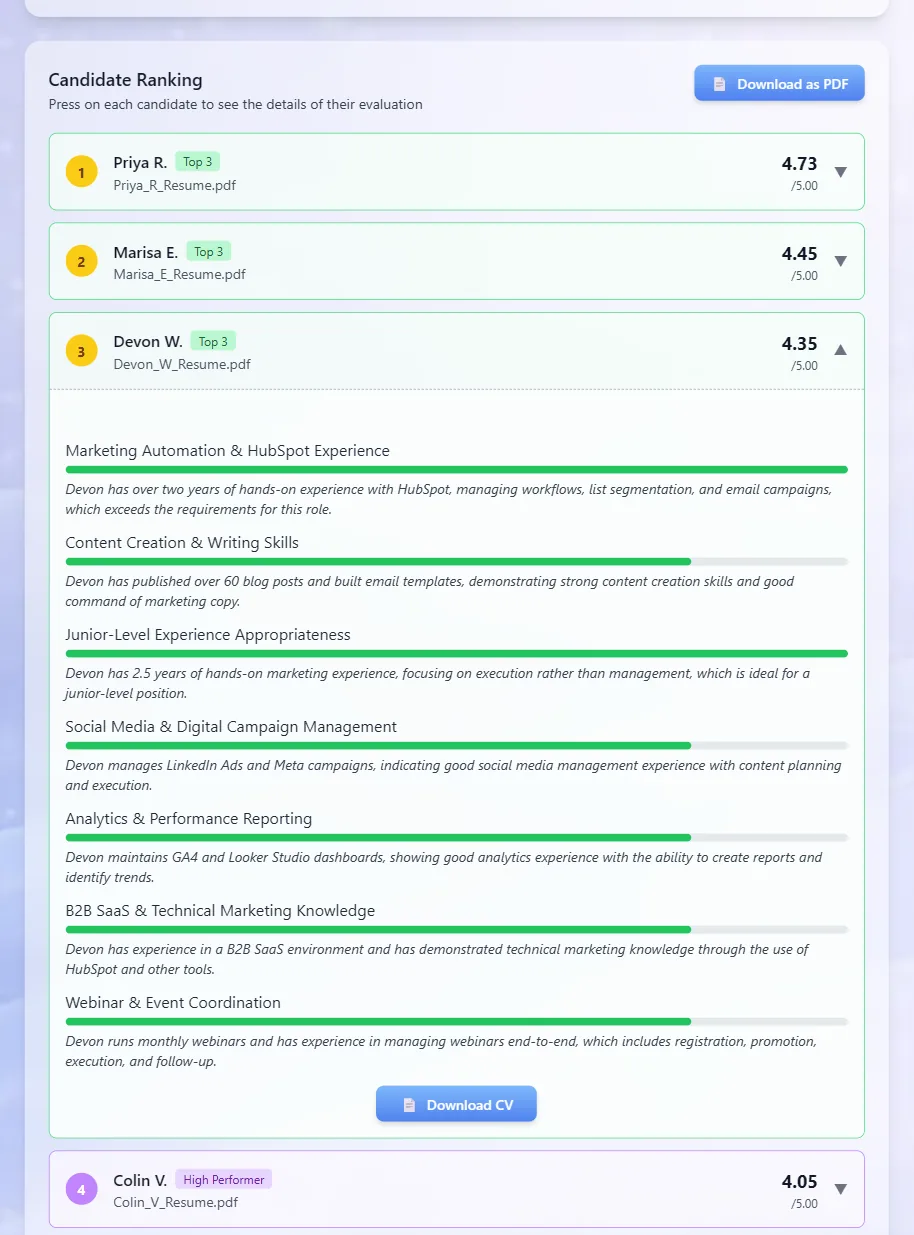
Read the reason behind every candidate's position — free, no credit card.
2. Prioritize Explainability
If you can’t explain a decision, you can’t defend it.
- Use systems that show why a candidate received a score
- Avoid black-box rankings
- Document decision criteria
Explainability is critical for both fairness and compliance.
3. Structure Evaluation Criteria
Unstructured evaluation increases bias.
- Define clear dimensions (e.g., skills, experience, role fit)
- Score consistently across candidates
- Align criteria directly with the job description
CandidatePilot uses structured scoring across defined criteria, helping standardize evaluation.
4. Avoid High-Risk Signals
Some AI capabilities introduce disproportionate risk:
- Facial recognition
- Voice analysis
- Behavioral inference (e.g., “confidence,” “personality”)
These systems are difficult to validate and often controversial. CandidatePilot deliberately does not use video, facial, or voice analysis.
5. Regularly Audit and Monitor
Bias mitigation is not a one-time task.
- Conduct periodic audits
- Track outcomes across demographic groups (where legally permissible)
- Adjust models and criteria as needed
Even well-designed systems can drift over time.
A Realistic Perspective
No AI system is bias-free. The goal is not perfection—it’s risk reduction, transparency, and accountability.
Organizations should be prepared to:
- Question their tools
- Document their processes
- Accept trade-offs between efficiency and fairness
Questions to Ask Your AI Vendor
Before adopting any AI hiring tool, ask these questions:
Transparency & Explainability
- How does the system generate scores or rankings?
- Can you provide detailed explanations for each decision?
- Is the model interpretable, or a black box?
Bias & Fairness
- How do you test for bias across demographic groups?
- Can you share results of recent bias audits?
- How do you handle proxy discrimination?
Compliance
- Are you compliant with NYC Local Law 144?
- How do you support California’s bias testing and record-keeping requirements?
- How does your system align with the EU AI Act?
Data & Privacy
- What data is used to train the model?
- How is candidate data stored and protected?
- What are your data retention policies?
Accessibility
- How does your system accommodate candidates with disabilities?
- Are alternative formats or workflows available?
Product Design Choices
- Do you use video, facial recognition, or voice analysis?
- If yes, how do you mitigate associated risks?
Human Oversight
- Can humans override AI decisions?
- How are recruiters expected to interact with the system?
If a vendor cannot answer these clearly, that’s a signal to proceed cautiously.
FAQ
Is AI hiring bias inevitable?
Bias is difficult to eliminate entirely, but it can be reduced. The key is transparency, structured evaluation, and ongoing monitoring.
Are AI hiring tools legal?
Yes—but increasingly regulated. Laws like NYC Local Law 144 and California’s 2025 regulations impose specific requirements.
Should companies stop using AI in hiring?
Not necessarily. AI can improve efficiency and consistency. The goal is to use it responsibly, not blindly.
What makes an AI screening tool “fair”?
Fairness involves:
- Clear evaluation criteria
- Explainable decisions
- Regular bias testing
- Human oversight
Is CandidatePilot bias-free?
No system is. CandidatePilot focuses on structured, explainable scoring and human-in-the-loop decision-making, which can help reduce risk compared to opaque systems—but it does not eliminate bias entirely.
AI is reshaping hiring—but it’s also reshaping accountability. Companies that understand and address AI recruitment bias will be better positioned to hire responsibly, comply with evolving regulations, and build trust with candidates.
The alternative—ignoring these risks—is becoming increasingly costly.
Try CandidatePilot free — explainable AI resume screening with structured criteria and human-in-the-loop decision-making.