
Introduction
Artificial intelligence is no longer a future concept in hiring—it is already embedded in how organizations attract, assess, and select talent. From resume screening and job description generation to candidate engagement and predictive analytics, AI in recruitment has moved from experimentation to operational reality.
In 2026, the conversation is no longer about whether to use AI in hiring, but how to use it responsibly and effectively. Organizations across industries are adopting AI recruitment tools to improve efficiency, reduce time-to-hire, and manage growing application volumes. At the same time, concerns around bias, transparency, privacy, and regulation have become central to decision-making.
The stakes are high. Hiring is one of the most consequential decisions a company makes—impacting performance, culture, diversity, and long-term success. Introducing artificial intelligence into that process creates both powerful advantages and meaningful risks.
Try AI screening on one role and judge the shortlist yourself — free, no credit card.
This article takes a balanced, practical look at AI recruiting benefits and risks in 2026. It covers what AI can realistically do today, where it adds measurable value, where it can go wrong, and what HR leaders and recruiters need to know to make informed decisions.
What AI Can Do in Recruitment Today
AI capabilities in recruitment have expanded significantly, but not all tools are equally mature. Understanding what works reliably—and what remains experimental—is essential.
1. Resume Screening and Candidate Ranking (High Maturity)
This is the most widely adopted use case. AI systems analyze resumes and match candidates against job requirements using structured criteria such as skills, experience, and keywords.
- Reduces manual review workload
- Standardizes evaluation criteria
- Enables ranking large applicant pools quickly
Platforms like CandidatePilot operate in this layer, focusing specifically on screening and ranking candidates efficiently.
2. Job Description Generation (High Maturity)
AI can generate or refine job descriptions based on role inputs, past listings, and market data.
- Improves clarity and consistency
- Reduces bias in language (when properly configured)
- Speeds up job posting creation
This is now a reliable, low-risk application used across organizations.
3. Candidate Matching and Talent Discovery (Medium-High Maturity)
AI tools can match candidates to roles beyond keyword matching, using semantic understanding and skill inference.
- Surfaces passive or overlooked candidates
- Improves internal mobility by matching existing employees to roles
- Helps recruiters identify non-obvious fits
While effective, outcomes depend heavily on data quality.
4. Interview Scheduling Automation (High Maturity)
AI-powered scheduling tools coordinate calendars, send reminders, and reduce back-and-forth communication.
- Eliminates administrative bottlenecks
- Improves candidate experience
- Reduces recruiter workload
This is one of the least controversial and most widely adopted AI use cases.
5. Chatbots and Candidate Engagement (Medium-High Maturity)
AI chatbots handle candidate queries, pre-screening questions, and application support.
- Available 24/7
- Improves response times
- Reduces drop-off during application
However, overly scripted or impersonal interactions can negatively impact candidate perception.
6. Video Interview Analysis (Medium Maturity)
Some tools analyze video interviews for communication patterns, tone, and behavioral indicators.
- Attempts to standardize evaluation
- Provides structured insights
This area remains controversial due to concerns about bias, accuracy, and scientific validity.
7. Predictive Analytics and Hiring Insights (Medium Maturity)
AI can analyze hiring data to predict outcomes such as candidate success, turnover risk, or hiring bottlenecks.
- Supports strategic workforce planning
- Identifies inefficiencies in hiring funnels
These systems are improving but still depend on high-quality historical data.
The Real Benefits (With Data)
AI in recruitment offers clear advantages—but the value is most visible when tied to measurable outcomes.
1. Speed and Time-to-Hire Reduction
Hiring is slow. The global average time-to-hire is approximately 42 days, and in many industries, it is longer.
AI significantly accelerates early-stage hiring:
- Screening time reduced by 50–70% (industry estimates)
- Recruiters spend about 23 hours per hire on screening alone
By automating resume review and initial filtering, AI allows recruiters to focus on high-value interactions like interviews and decision-making.
2. Scalability
Modern hiring involves high application volumes. A single role can receive hundreds—or thousands—of applications.
AI enables organizations to:
- Process large candidate pools instantly
- Maintain consistent evaluation standards
- Avoid backlog during hiring surges
This is especially important for fast-growing companies or high-turnover roles.
This is what it looks like in CandidatePilot. The whole applicant pool for one role goes in at once — up to 400 resumes per process.
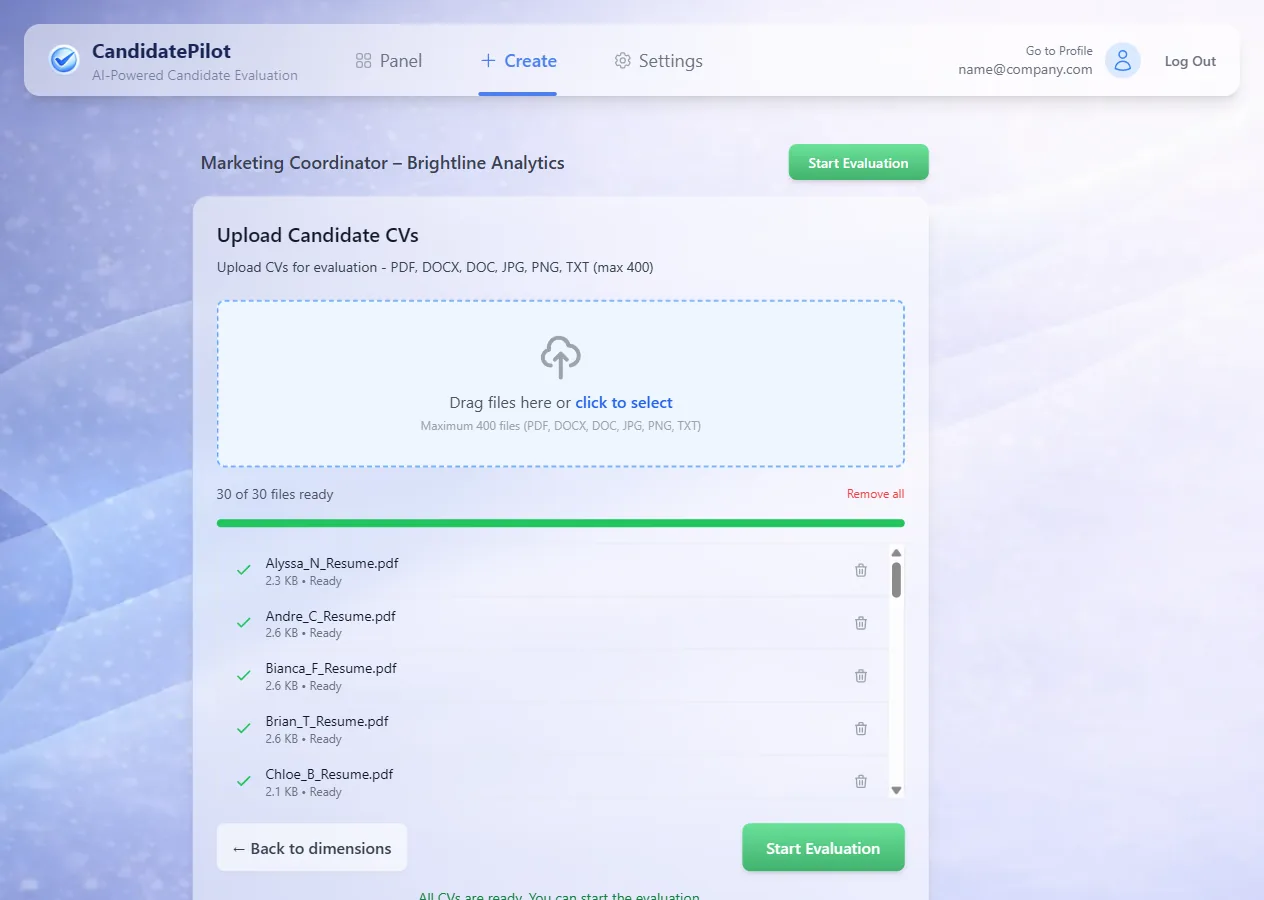
Screen a few hundred applicants in one pass — free, no credit card.
3. Consistency and Standardization
Human decision-making is inherently variable. Different recruiters may evaluate the same candidate differently.
AI introduces structured evaluation:
- Applies the same criteria across all candidates
- Reduces variability in early-stage screening
- Improves fairness when properly designed
However, consistency is only valuable if the criteria themselves are unbiased.
4. Cost Efficiency
Reducing manual effort translates into cost savings:
- Fewer hours spent on screening
- Lower dependency on external recruiters
- Faster hiring reduces vacancy costs
Even modest efficiency gains can have significant financial impact at scale.
5. Data-Driven Decision Making
AI tools provide insights that are difficult to generate manually:
- Funnel conversion rates
- Source effectiveness
- Candidate drop-off points
These insights help organizations optimize their hiring strategies over time.
6. Market Growth Signals
The adoption of AI in recruitment reflects broader market trends:
- The global AI recruitment market is projected to grow from ~$596 million in 2025 to $920 million by 2031, with a CAGR of 7.52%
- In Latin America, the HR tech market is expected to grow from $1,254 million (2025) to $2,204 million by 2034
- 47% of LATAM enterprises are already implementing AI solutions
These figures indicate that AI hiring tools are becoming standard infrastructure rather than optional innovation.
The Real Risks (Honestly)
While the benefits are compelling, the risks are equally real—and often underestimated.
1. Algorithmic Bias
AI systems learn from historical data. If that data reflects bias, the system can replicate or amplify it.
A well-known University of Washington study found that AI screeners preferred white-associated names 85% of the time over equally qualified alternatives.
Risks include:
- Reinforcing existing hiring biases
- Discriminating against protected groups
- Creating legal exposure
Bias is not a theoretical concern—it is a documented reality.
2. Over-Reliance on Automation
AI should support decisions, not replace them.
Over-reliance can lead to:
- Ignoring strong candidates who don’t match predefined criteria
- Reduced critical thinking in hiring decisions
- “Black box” decision-making
Human judgment remains essential, particularly in later hiring stages.
3. Data Privacy and Security
AI recruitment systems process sensitive personal data:
- Resumes
- Interview recordings
- Behavioral insights
Risks include:
- Data breaches
- Misuse of candidate information
- Non-compliance with privacy regulations
Organizations must ensure strong data governance and transparency.
4. Regulatory and Legal Risk
As governments introduce stricter rules, non-compliance becomes a major risk.
Failure to comply can result in:
- Fines
- Legal challenges
- Reputational damage
This is especially relevant in regions with emerging AI hiring regulations.
5. Candidate Experience Concerns
AI can improve efficiency—but also depersonalize hiring.
Common issues:
- Lack of human interaction
- Opaque decision-making
- Frustration with automated rejections
Candidates increasingly expect transparency about how AI is used.
6. “Garbage In, Garbage Out” (GIGO)
AI systems are only as good as the data and criteria they use.
Poor inputs lead to:
- Irrelevant candidate rankings
- Missed high-potential candidates
- Misaligned hiring outcomes
Organizations must define clear, high-quality job requirements.
The Regulatory Landscape
Regulation is rapidly evolving—and shaping how AI can be used in hiring.
United States
- New York City Local Law 144 requires bias audits for automated employment decision tools and mandates transparency to candidates
- California introduced regulations (effective October 2025) focusing on transparency, data usage, and fairness in AI-driven hiring systems
- Illinois regulates AI use in video interviews, requiring consent and disclosure
These laws signal a shift toward accountability and explainability.
Europe
The EU’s AI Act (phased implementation) classifies hiring AI systems as “high-risk,” requiring:
- Risk assessments
- Transparency
- Human oversight
- Documentation and auditing
This is one of the most comprehensive regulatory frameworks globally.
Latin America
While regulation is less mature, adoption is accelerating:
- Nearly half of enterprises are already implementing AI
- Governments are beginning to explore AI governance frameworks
Expect more formal regulations in the coming years.
What’s Next
Key trends in regulation:
- Mandatory bias audits
- Increased transparency requirements
- Candidate rights to explanation
- Stronger data protection standards
Organizations adopting AI in recruitment today must plan for compliance—not just functionality.
How to Implement AI in Hiring
Successful implementation is less about the tool—and more about the approach.
1. Start with a Specific Use Case
Begin with high-impact, low-risk applications:
- Resume screening
- Scheduling automation
- Job description generation
Avoid trying to automate the entire hiring process at once.
2. Choose Explainable Tools
Transparency matters.
Look for systems that:
- Provide clear reasoning for decisions
- Allow visibility into ranking criteria
- Enable auditing and validation
Avoid “black box” solutions when possible.
3. Keep Humans in the Loop
AI should augment—not replace—human judgment.
Best practices:
- Use AI for initial filtering
- Maintain human review for final decisions
- Encourage recruiters to challenge AI outputs
This reduces risk and improves decision quality.
4. Audit Regularly
Bias and performance should be continuously monitored.
- Conduct internal audits
- Review outcomes across demographic groups
- Adjust models and criteria as needed
Compliance is not a one-time activity.
5. Train Your Team
Technology adoption fails without user understanding.
- Educate recruiters on how AI works
- Clarify limitations and risks
- Promote responsible usage
Trust and effectiveness depend on proper training.
6. Prioritize Candidate Transparency
Candidates should know when AI is involved.
- Disclose AI usage clearly
- Provide feedback when possible
- Maintain human touchpoints
This builds trust and improves employer brand.
FAQ
What is AI in recruitment?
AI in recruitment refers to the use of artificial intelligence to automate or enhance hiring processes, including screening, matching, communication, and analytics.
Is AI replacing recruiters?
No. AI is changing the role of recruiters, not replacing them. It handles repetitive tasks, allowing recruiters to focus on strategy, relationships, and decision-making.
Are AI hiring tools biased?
They can be. Bias depends on data, design, and implementation. Proper auditing and oversight are essential to minimize risk.
Is AI in hiring legal?
Yes, but increasingly regulated. Laws in regions like the U.S. and EU require transparency, audits, and compliance with fairness standards.
What is the future of AI hiring?
The future of AI hiring will likely involve:
- Greater regulation
- More explainable systems
- Deeper integration with HR workflows
- Increased focus on ethical use
Where should companies start?
Start with a focused use case like screening or scheduling, use transparent tools, and maintain human oversight.
AI in recruitment is neither a silver bullet nor a threat—it is a tool. Its value depends on how it is implemented, governed, and integrated into human decision-making. Organizations that approach it thoughtfully will gain efficiency and insight, while those that adopt it blindly risk reinforcing the very problems they aim to solve.
Try CandidatePilot free — start with AI screening. Upload your job description, add resumes, and get a ranked shortlist with explanations in minutes.