
Introduction
Hiring in 2026 is paradoxical for startups. On one hand, there are more applicants than ever. On the other, 85% of small business owners report receiving few or no qualified applicants, and 33% say they have roles they simply can’t fill (NFIB, Feb 2026).
That tension explains why hiring tools matter more than ever.
At the same time, most early-stage companies don’t operate like enterprises. You don’t have a recruiting team, structured interview loops, or months to evaluate tools. You’re trying to make fast, high-stakes hires—often while juggling product, fundraising, and growth.
Upload your job description and resumes and get a ranked shortlist in minutes — free, no credit card, and no ATS to set up.
Meanwhile, the hiring tech landscape keeps expanding. The ATS market alone is projected to grow from $17.22B in 2025 to $34.83B by 2034, reflecting how central these tools have become. Even today, 97.8% of Fortune 500 companies use an ATS.
But here’s the key difference: Startups don’t need the same tools as enterprises.
Choosing the wrong system too early can slow you down, add unnecessary cost, and create process overhead you don’t need. With the average cost-per-hire at $4,700 (SHRM), the goal isn’t just to hire faster—it’s to hire smarter.
This guide breaks down the best ATS for startups in 2026, including free and paid options, based on your stage—not just feature lists.
What Startups Need vs. Enterprise Hiring Tools
Enterprise hiring is built for scale. Startup hiring is built for speed.
That difference shapes everything—from the tools you should choose to how much process you actually need.
1. Speed over process
Large companies optimize for consistency and compliance. They design structured workflows with multiple stakeholders, interview scorecards, and approvals.
Startups optimize for:
- Moving fast on candidates
- Reducing friction
- Making decisions quickly
An overly complex ATS can actually slow you down at this stage.
2. Simplicity over customization
Enterprise ATS platforms like Lever or Greenhouse are powerful—but they’re designed for:
- Dedicated recruiters
- Multi-stage pipelines
- Advanced reporting
Early-stage teams usually need:
- A simple pipeline
- Resume organization
- Basic communication tools
Anything beyond that can feel like overkill.
3. Low cost (or free) matters
Recruiting software pricing varies widely:
- Entry-level tools: ~$15/user/month
- SMB tools: $100–$400/month
- Enterprise systems: $6,000–$100,000+/year (Leonar)
For a startup hiring a handful of people, that’s a major decision.
Especially when:
- Hiring is inconsistent
- Budgets are tight
- ROI is uncertain
4. Screening is often the real bottleneck
Many founders assume they need a full ATS.
In reality, the biggest pain point is usually:
- Too many unqualified resumes
- Not enough time to review them
That’s where tools like CandidatePilot fit in—not as an ATS, but as a screening layer before you even need one.
ATS by Startup Stage
The biggest mistake founders make is choosing an ATS too early—or too late.
The right tool depends almost entirely on your hiring volume and complexity.
Pre-seed (0–5 hires/year)
At this stage, you’re likely:
- Hiring occasionally
- Managing candidates manually
- Prioritizing cost (often $0)
What you actually need
- Resume organization
- Basic filtering
- Lightweight tracking
What you don’t need
- Advanced analytics
- Complex pipelines
- Expensive subscriptions
Best options
1. Spreadsheets + email
Still the default for many founders.
Pros:
- Free
- Flexible Cons:
- Easy to lose candidates
- No structure
2. CandidatePilot (screening layer)
- AI resume screening
- Up to 400 resumes
- No pipeline or ATS features
Best used for:
- Quickly identifying top candidates
- Reducing manual review time
Important: This is not an ATS—it replaces the screening step, not the entire hiring workflow.
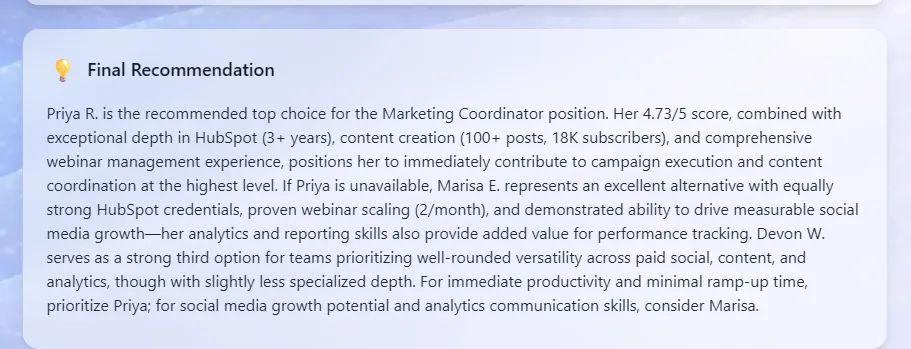
This is what it looks like in CandidatePilot. The recommended top three for the role, with a short written reason to prioritize each one.
Get a shortlist without setting up an ATS — free, no credit card.
3. Breezy HR (Free plan)
- Free “Bootstrap” plan
- 1 active job
- Visual pipeline
Good for:
- First structured hiring process
- Simple workflows
4. Zoho Recruit (Free plan)
- Free forever tier
- 1 active job
- Basic candidate tracking
Good for:
- Bootstrapped startups
- Teams already using Zoho tools
Pre-seed comparison
| Tool | Cost | Best for |
|---|---|---|
| Spreadsheets | Free | Very early hiring |
| CandidatePilot | Free | Resume screening |
| Breezy HR | Free | Basic pipeline |
| Zoho Recruit | Free | Simple ATS |
Seed / Series A (5–25 hires/year)
This is where hiring starts breaking without structure.
You’re likely:
- Hiring across multiple roles
- Receiving dozens or hundreds of applications
- Coordinating across founders and hiring managers
What you need now
- Pipeline management
- Job posting
- Candidate communication
- Basic automation
Best ATS for startups at this stage
1. Manatal
- Starts at ~$15/user/month (Leonar)
- AI-powered candidate recommendations
- Strong value for small teams
Best for:
- Cost-conscious teams
- Multi-role hiring
2. Breezy HR (Paid)
- Starts around $157/month (RecruitCompare)
- Visual pipeline
- Built-in automation
Best for:
- Ease of use
- Non-technical hiring managers
3. Zoho Recruit (Paid tiers)
- Freemium → scalable pricing
- ATS + CRM hybrid
- Integrates with Zoho ecosystem
Best for:
- Teams already using Zoho
4. Workable
- Starts around $149/month (Leonar)
- Strong sourcing tools
- Good candidate experience
Best for:
- Scaling hiring teams
Seed-stage comparison
| Tool | Pricing | Strength |
|---|---|---|
| Manatal | ~$15/user/month | Affordable + AI |
| Breezy HR | ~$157/month | Simple UI |
| Zoho Recruit | Freemium | Flexible |
| Workable | ~$149/month | Sourcing tools |
Series B+ (25+ hires/year)
At this point, hiring becomes a system—not a task.
You likely have:
- Dedicated recruiters
- Structured interview processes
- Data-driven hiring decisions
What you need now
- Advanced analytics
- Structured interviews
- Integrations (HRIS, payroll, etc.)
- Scalable workflows
Best ATS for scaling startups
1. Ashby
- Starts around $300/month (Sloneek)
- Strong analytics
- All-in-one recruiting platform
Best for:
- Data-driven teams
2. Lever
- ATS + CRM hybrid
- Strong sourcing workflows
Best for:
- High-growth startups
3. Greenhouse
- Enterprise-grade ATS
- Deep integrations
- Structured hiring focus
Best for:
- Mature hiring organizations
Series B+ comparison
| Tool | Pricing | Strength |
|---|---|---|
| Ashby | ~$300/month | Analytics |
| Lever | Custom | ATS + CRM |
| Greenhouse | Custom | Enterprise features |
Do You Actually Need an ATS?
Short answer: not always.
Many founders assume:
“We’re hiring → we need an ATS.”
That’s not necessarily true.
You probably don’t need an ATS if:
- You hire fewer than 3–5 people/year
- You can track candidates in a spreadsheet
- Your main issue is resume overload (not process)
In these cases, a screening tool like CandidatePilot plus lightweight tracking is often enough.
You likely need an ATS if:
- You’re hiring for multiple roles simultaneously
- Candidates are slipping through the cracks
- Coordination between interviewers is messy
The real decision: screening vs. system
Most hiring problems fall into two categories:
- Too many applicants → need screening
- Too many moving parts → need an ATS
Understanding which one you have saves time and money.
If yours is the first one, what you need is a screening tool rather than an ATS — we compared the options in our guide to candidate screening software for small teams.
ATS Comparison Table (2026)
| Tool | Free Plan | Starting Price | Best For |
|---|---|---|---|
| CandidatePilot | Yes | Free | Resume screening |
| Breezy HR | Yes | $157/month | Small teams |
| Zoho Recruit | Yes | Freemium | Bootstrapped startups |
| Manatal | No | $15/user/month | Affordable ATS |
| Workable | No | $149/month | Scaling teams |
| Ashby | No | ~$300/month | Data-driven hiring |
| Lever | No | Custom | Growth-stage startups |
| Greenhouse | No | Custom | Enterprise hiring |
FAQ
What is the best ATS for startups in 2026?
It depends on your stage:
- Pre-seed: Breezy HR (free), Zoho Recruit
- Seed: Manatal, Workable
- Series B+: Ashby, Lever, Greenhouse
What is the best free ATS for startups?
Top free options include:
- Breezy HR (1 active job)
- Zoho Recruit (limited free plan)
These are ideal for early-stage teams with minimal hiring needs.
Do startups need an ATS from day one?
No. Many startups can operate effectively with spreadsheets and basic tools until hiring becomes frequent or complex.
What’s the difference between CandidatePilot and an ATS?
- CandidatePilot: Resume screening only
- ATS: Full hiring workflow (pipeline, communication, job posting)
They solve different problems.
How much should a startup spend on an ATS?
Typical ranges:
- Free → early stage
- $15–$200/month → small teams
- $300+/month → scaling companies (SelectSoftware Reviews)
What’s the biggest hiring challenge for startups?
Beyond tools, it’s candidate quality:
- 85% report few qualified applicants
- Nearly half cite salary expectations as the main challenge
Tools help—but they don’t replace positioning, compensation, and employer brand.
Final Thoughts
There is no single “best ATS for startups”—only the best tool for your current stage.
- Early stage → keep it simple (or free)
- Growth stage → add structure
- Scale stage → invest in systems
And before committing to any ATS, ask one question:
Is your problem process—or screening?
Because solving the wrong one is how startups end up paying for tools they don’t actually need.
Try CandidatePilot free — upload your job description, add your resumes, and get a ranked shortlist in minutes. No ATS required.