
Introduction
Hiring software has quietly become one of the most confusing — and expensive — parts of building a team.
If you’ve been researching tools, you’ve probably seen wildly different categories mixed together: ATS platforms, AI screening tools, video interview systems, CRM-style recruiting tools. And the pricing? It ranges from completely free to well over $100,000 per year.
At the enterprise end, tools like HireVue start around $35,000/year, with additional implementation costs. Mid-market platforms like Lever can scale into six figures annually depending on team size. Even “SMB-friendly” tools like Workable still run hundreds per month — before add-ons.
Upload your job description and resumes and get a ranked shortlist in minutes — free, no credit card, up to 400 resumes per job.
So the real question isn’t which tool is best.
It’s:
Do you actually need a full hiring system — or just one piece of it?
Because most teams don’t need everything:
- Not everyone needs video interviews with AI analysis
- Not everyone needs a full ATS + CRM
- Not everyone needs to pay thousands just to screen resumes
And that’s where tools like CandidatePilot come in — focused, free, and built for a very specific part of the process.
This guide breaks down four very different tools side-by-side so you can decide what you actually need — and avoid paying for what you don’t.
The 4 contenders at a glance
Here’s the simplest way to understand these tools: they are not competing head-to-head in the same category.
| Tool | Category | Pricing | AI Depth | Best For | Free Option |
|---|---|---|---|---|---|
| HireVue | Video interviews + assessments | From ~$35K/year + $5–15K implementation | Very deep (25,000+ data points per interview) | Enterprise, high-volume hiring | No |
| Lever | ATS + CRM (LeverTRM) | ~$6K–$140K/year | Strong (matching, screening, bias mitigation) | Mid-market & scaling teams | No |
| Workable | All-in-one ATS | $299–$719/month + add-ons | Strong (AI screening, new agent AI) | SMBs & startups | 15-day trial |
| CandidatePilot | Resume screening tool | Free | Focused (contextual AI scoring + ranking) | Early-stage, lean teams | Yes (free) |
Key takeaway
- HireVue = deep AI + interviews
- Lever = structured recruiting system + pipeline
- Workable = all-in-one hiring toolkit
- CandidatePilot = just resume screening (but done well and free)
This distinction matters because many teams overbuy.
If your bottleneck is screening 150 resumes, you don’t need a $40K platform. If your bottleneck is coordinating a hiring team across 20 roles, a free tool won’t cut it.
Let’s break each one down properly.
HireVue — enterprise-grade AI video interviews
HireVue sits firmly at the enterprise end of the hiring spectrum.
What it is
HireVue is a video interview and assessment platform designed for large organizations hiring at scale.
Candidates record video responses to structured questions, and HireVue’s AI analyzes those responses using:
- Voice patterns
- Facial expressions
- Body language
- Word choice
- Behavioral indicators
According to vendor and third-party sources (HireVue, Capterra, RemotelyTalents), the platform evaluates 25,000+ data points per interview.
It also includes:
- Game-based cognitive assessments
- Structured interview workflows
- Integration with enterprise HR systems
Pricing
- Starting point: ~$35,000/year
- Implementation: $5,000–$15,000 additional
- No free trial or free tier
Pricing scales significantly with company size and hiring volume.
AI capabilities
This is where HireVue stands out.
It’s not just screening resumes — it’s evaluating candidate behavior at scale.
That makes it powerful for:
- High-volume recruiting (retail, call centers, grad programs)
- Standardizing interviews across large teams
- Reducing manual interview load
Best for
- Fortune 500 companies
- Enterprises hiring thousands of candidates
- Organizations needing structured, scalable interview processes
HireVue reports 700+ enterprise clients, including nearly half of the Fortune 100.
Limitations
- Extremely expensive for small teams
- Overkill for low hiring volume
- Requires implementation and training
- Controversial in some regions due to AI bias concerns
- Doesn’t replace an ATS — it complements one
Bottom line
HireVue is powerful — but only if you’re operating at scale.
If you’re hiring 10–50 people a year, this is likely unnecessary.
Lever — mid-market ATS + CRM
Lever (LeverTRM) sits in the middle of the market: more robust than SMB tools, but more accessible than enterprise suites.
What it is
Lever combines:
- ATS (Applicant Tracking System)
- CRM (candidate relationship management)
This is its defining feature.
Instead of just tracking applicants, Lever helps you:
- Build talent pipelines
- Nurture passive candidates
- Manage outreach and engagement over time
Pricing
- ~$75 per user/month (starting point)
- Typical contracts: $6,000–$140,000/year
- Annual contracts only
- No free tier (demo required)
(Sources: Vendr, HeroHunt, Pin.com)
AI capabilities
Lever has significantly expanded AI features:
- Resume screening automation
- Candidate matching (“Talent Fit”)
- AI Interview Companion
- Bias mitigation via IBM watsonx.governance
This is practical AI, focused on workflow efficiency rather than experimental analysis.
Best for
- Scaling startups (50–500 employees)
- Recruiting teams managing multiple roles
- Companies doing outbound recruiting
- Teams that want pipeline visibility and collaboration
Limitations
- Not cheap for small teams
- Requires setup and process discipline
- Overkill if you just need resume sorting
- AI is helpful but not transformative on its own
Where Lever shines
The CRM component is what makes Lever different.
If your hiring strategy includes:
- Proactive sourcing
- Long-term candidate pipelines
- Relationship tracking
Lever becomes much more valuable than a basic ATS.
Bottom line
Lever is a strong choice if you’re building a repeatable recruiting system — not just filling a role.
Workable — SMB-friendly all-in-one
Workable is often positioned as the most accessible full ATS for smaller teams.
What it is
Workable is an all-in-one hiring platform that includes:
- Job posting to multiple boards
- Applicant tracking
- Interview scheduling
- Candidate evaluation tools
- Basic HR features
It’s designed to be easy to start and scale gradually.
Pricing (March 2026)
- Standard: $299/month (1–20 employees)
- Premier: $599/month
- Enterprise: $719/month
Add-ons:
- Video interviews: $99/month
- Assessments: $59/month (included in higher tiers)
Free trial: 15 days (no credit card required) (Source: Workable pricing page, GlobeNewswire)
AI capabilities
Workable has invested heavily in AI:
- AI Screening Assistant (semantic resume analysis)
- Candidate anonymization (bias reduction)
- Salary intelligence
- NEW (March 2026): Workable Agent
The Workable Agent is particularly notable — an “agentic AI” that helps automate parts of the hiring workflow, moving toward end-to-end assistance.
Best for
- Startups hiring consistently
- SMBs without dedicated recruiting ops
- Teams that want everything in one place
Limitations
- Costs add up with add-ons
- Less customizable than enterprise tools
- CRM capabilities are limited compared to Lever
- Still requires onboarding and process setup
Where Workable shines
- Fast setup
- Balanced feature set
- Clear pricing (compared to enterprise tools)
Bottom line
Workable is a strong default ATS for startups that want structure without enterprise complexity.
CandidatePilot — free AI resume screening
CandidatePilot is fundamentally different from the other three tools.
It is not an ATS.
What it is
CandidatePilot focuses on one problem:
Screening and ranking resumes quickly — using AI.
How it works:
- Upload your job description
- AI identifies what to evaluate based on the role
- Upload up to 400 resumes
- AI evaluates each resume and produces a ranked shortlist with explanations
- You get a Top 3 recommendation with pros, cons, interview guide, and a downloadable PDF report
No setup, no contracts, no demo required.
Pricing
- Free
- No limits on usage beyond per-process constraints
- No sales involvement
AI capabilities
CandidatePilot’s AI is focused and transparent:
- Identifies evaluation criteria from the job description
- Evaluates each resume against those criteria
- Provides written explanations for every assessment
- Produces structured outputs (rankings, summaries, guides)
This is different from black-box scoring systems.
Best for
- Startups with no ATS
- Recruiters screening large resume batches
- Teams testing candidates before committing to tools
- Anyone searching for “free AI resume screening”
Limitations (important)
- Not an ATS — no pipeline management
- No job posting or sourcing
- No CRM or candidate tracking
- No interview scheduling or collaboration features
- Limited to 400 resumes per process
Where it fits
CandidatePilot is best seen as:
- A pre-ATS tool
- Or a complement to an ATS
Example:
- Use CandidatePilot to shortlist → move top candidates into Workable or Lever
Bottom line
CandidatePilot is the best option if your main problem is resume screening and you want to spend $0.
If you need a full hiring system, it won’t replace one.
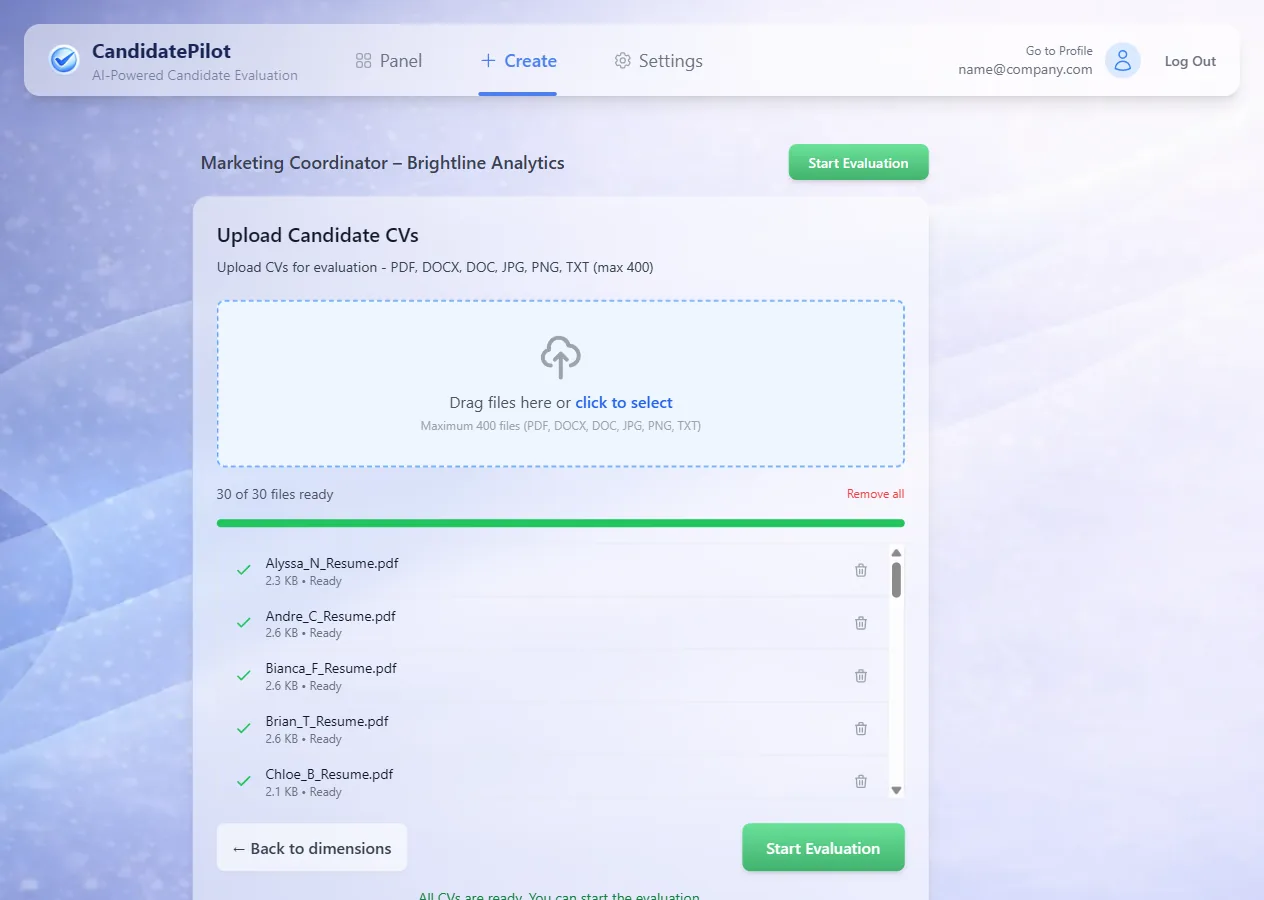
This is what it looks like in CandidatePilot. A batch of resumes uploaded for one role, ready to be evaluated in a single pass.
Just use it — free, no credit card.
Which tool do you actually need?
Here’s the practical decision framework.
Scenario 1: “We just need to screen resumes faster”
Use:
- CandidatePilot
Why:
- Free
- Fast
- No setup
- Focused on your bottleneck
You don’t need an ATS yet.
Scenario 2: “We’re hiring consistently but still small”
Use:
- Workable
Why:
- All-in-one system
- Reasonable pricing
- Easy to implement
- Includes AI features
Optional:
- Add CandidatePilot for better screening quality
Scenario 3: “We’re scaling and need structure”
Use:
- Lever
Why:
- Pipeline management
- CRM for passive candidates
- Collaboration across hiring teams
This is where ATS complexity starts to pay off.
Scenario 4: “We hire at massive scale”
Use:
- HireVue (+ ATS)
Why:
- Automates interviews at scale
- Deep AI analysis
- Reduces interviewer workload
But note: you’ll still need an ATS alongside it.
Important insight
These tools are not mutually exclusive.
Common combinations:
- CandidatePilot + Workable
- CandidatePilot + Lever
- Lever + HireVue
Think of them as layers:
- Screening → CandidatePilot
- Pipeline → Workable / Lever
- Interviews at scale → HireVue
FAQ
1. What are the best HireVue alternatives?
It depends on what you’re replacing:
- For video interviews → alternatives include Spark Hire or Willo
- For resume screening → CandidatePilot is a free alternative
- For full hiring systems → Lever or Workable
HireVue is unique in its depth, so most alternatives replace only parts of it.
2. Lever vs Workable: which is better?
Choose Workable if you want:
- Simplicity
- Faster setup
- Lower cost
Choose Lever if you want:
- CRM functionality
- Pipeline building
- Long-term recruiting strategy
Workable = easier Lever = more powerful
3. Is there a truly free AI resume screening tool?
Yes — CandidatePilot.
It offers:
- AI scoring
- Ranking
- Explanations
- Interview guides
Without requiring payment, demo, or contract.
4. Do startups need an ATS?
Not always.
If you’re:
- Hiring occasionally
- Screening <400 resumes
- Not collaborating heavily
You can start with a tool like CandidatePilot.
You’ll need an ATS when:
- Hiring becomes frequent
- Multiple stakeholders are involved
- You need structured pipelines
5. Can you combine these tools?
Yes — and many teams do.
Typical stack:
- CandidatePilot → screening
- Workable or Lever → pipeline
- HireVue → interviews (if needed)
The key is not to overbuild too early.
Final thought
Most hiring teams don’t fail because they lack tools.
They fail because they buy the wrong tool for their actual problem.
- If your problem is screening → don’t buy an ATS
- If your problem is coordination → don’t rely on spreadsheets
- If your problem is scale → don’t manually interview
Start with the bottleneck.
Then choose the smallest tool that solves it.
Try CandidatePilot free — upload your job description, add your resumes, and get a ranked shortlist in minutes.