
Introduction
You spend 42 days hiring for a role. You invest roughly $4,700 in recruitment costs. You onboard, train, and integrate a new employee.
Six months later, they’re gone.
Whether they quit, underperform, or need to be let go, the outcome is the same: you’re back at square one—except now you’ve lost time, money, and momentum.
According to Society for Human Resource Management, the cost of a bad hire ranges from 50% to 200% of the employee’s annual salary. Meanwhile, the United States Department of Labor widely reports that a bad hire costs at least 30% of first-year earnings—a conservative baseline.
Put simply: hiring mistakes are not just inconvenient. They are one of the most expensive operational risks a company faces.
And yet, they’re common.
Despite growing investment in hiring tools and processes, most teams still rely on manual resume screening, subjective judgment, and inconsistent evaluation criteria. The result? Weak shortlists, misaligned hires, and costly turnover.
Screen every resume against the role before you shortlist — free, no credit card.
This article breaks down:
- The real, data-backed cost of a bad hire
- The often-overlooked ripple effects
- Why hiring mistakes happen in the first place
- And how to reduce them—starting at the screening stage
What a Bad Hire Actually Costs
The phrase “cost of a bad hire” is often cited, but rarely broken down. In reality, it’s a combination of direct costs, indirect costs, and opportunity costs.
Let’s unpack each one.
1. Direct Costs
These are the most visible—and easiest to measure.
- Cost-per-hire: $4,700 on average (SHRM, 2023)
- Recruitment spend: job boards, recruiter fees, tools
- Onboarding and training: time, materials, manager involvement
- Salary and benefits paid during underperformance
- Severance or termination costs
Across industries, estimates suggest:
- Entry-level bad hire: ~$17,000
- Senior-level bad hire: $240,000+
These figures aggregate data from SHRM and the U.S. Department of Labor.
2. Indirect Costs
Indirect costs are harder to quantify—but often larger.
They include:
- Manager time spent correcting mistakes
- Team productivity loss
- Rework or errors caused by underperformance
- Delayed projects
3. Opportunity Costs
This is where the real damage compounds.
A bad hire doesn’t just cost money—it blocks value creation.
- The role remains effectively unfilled
- High-quality candidates may have been passed over
- Strategic initiatives stall
Example: $60K Role
Let’s assume a mid-level hire with a $60,000 salary.
- Direct costs (30–50%): $18,000–$30,000
- Replacement hiring cost: ~$4,700
- Lost productivity: ~$15,000+
Estimated total cost: Estimated total: $37,700 to $50,000+
Example: $120K Role
Now consider a senior hire at $120,000.
- Direct costs (50–200%): $60,000–$240,000
- Recruitment + onboarding: ~$10,000+
- Strategic delays and missed outcomes: significant
Estimated total cost: Estimated total: $70,000 to $250,000+
These numbers illustrate a critical point:
Hiring mistakes scale with seniority—but they’re expensive at every level.
The Hidden Costs
While financial losses are measurable, the hidden costs of a bad hire often have longer-lasting effects.
1. Team Morale
A survey by SHRM of over 2,100 CFOs found that:
95% say a bad hire negatively impacts team morale
This shows up in several ways:
- Increased workload for others
- Frustration with underperformance
- Erosion of trust in leadership decisions
Morale damage can persist even after the employee leaves.
2. Customer Impact
In customer-facing roles, the consequences extend externally:
- Poor service quality
- Lost accounts or churn
- Brand damage
One underperforming hire can undo months of relationship-building.
3. Knowledge Loss and Disruption
Even short-tenure hires absorb institutional knowledge.
When they leave:
- That knowledge walks out the door
- Teams must re-train replacements
- Work continuity is disrupted
4. Recruiter and Manager Burnout
Hiring is resource-intensive.
When a hire fails:
- Recruiters restart the process from scratch
- Hiring managers lose confidence in the pipeline
- Decision fatigue increases
Over time, this leads to:
- Slower hiring cycles
- Lower hiring quality
- Higher turnover risk
5. Culture Drift
Bad hires don’t just fail individually—they can affect team norms.
- Misaligned values
- Reduced accountability
- Lower performance standards
Culture erosion is subtle—but costly.
Why Bad Hires Happen
Despite the stakes, hiring mistakes are common. The causes are surprisingly consistent across companies.
1. Rushed Hiring Decisions
When roles stay open for too long, pressure builds.
The average time to hire is 42 days, but many teams:
- Cut corners after 30+ days
- Lower standards to “fill the gap”
- Prioritize speed over fit
This trade-off often backfires.
2. Overreliance on Gut Feeling
Hiring decisions frequently rely on:
- First impressions
- “Culture fit” intuition
- Interview chemistry
While instinct plays a role, it introduces:
- Bias
- Inconsistency
- Poor predictive accuracy
3. Unstructured Interviews
Without standardized evaluation:
- Candidates are assessed differently
- Questions vary widely
- Feedback is subjective
This reduces comparability and increases error rates.
4. Weak Candidate Pools
One of the most overlooked drivers of bad hires is input quality.
According to Lighthouse Research & Advisory, analyzing 50,000+ resumes:
Only 4.66% of applicants meet 80%+ of job requirements
That means:
- Most shortlists are built from weak pools
- Recruiters spend time filtering noise
- Strong candidates can be missed
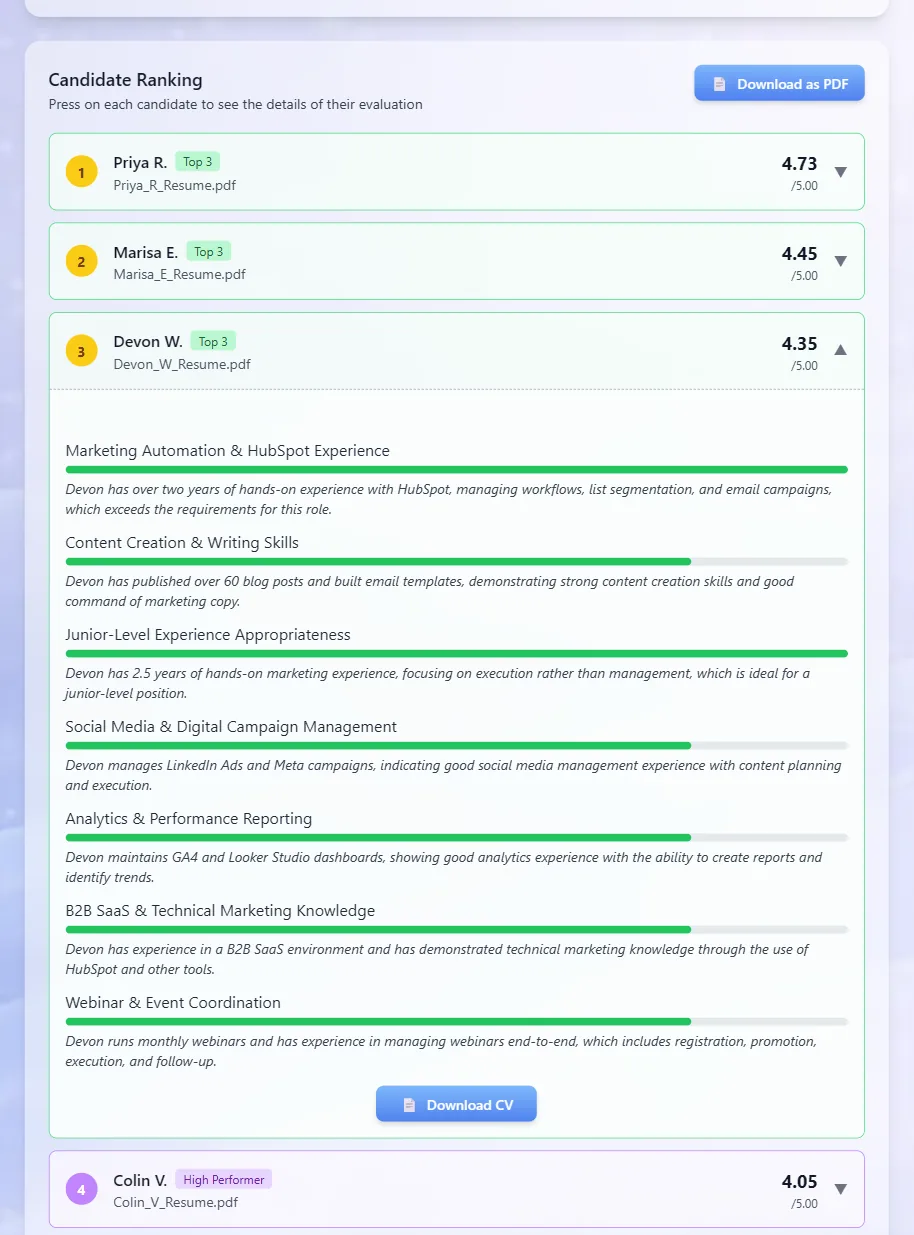
This is what it looks like in CandidatePilot. The ranked list for a role, with the reason the leading candidate came first spelled out.
Stop losing strong candidates in a weak shortlist — free, no credit card.
5. Manual Resume Screening
Traditional screening is:
- Time-consuming
- Inconsistent
- Prone to human error
Under pressure, recruiters may:
- Skim resumes
- Overlook relevant experience
- Favor familiar backgrounds
This is where many hiring mistakes begin—not at the interview stage, but at the shortlist stage.
How AI Screening Reduces Bad Hires
Improving hiring outcomes starts with improving who gets shortlisted.
This is where AI-driven screening tools like CandidatePilot come in.
1. Consistency at Scale
AI evaluates every resume against the same criteria:
- Skills
- Experience
- Relevance to role requirements
This removes variability introduced by:
- Human fatigue
- Time pressure
- Subjective judgment
2. Better Signal from Noisy Data
Given that fewer than 5% of applicants strongly match a role, screening is a signal extraction problem.
AI helps by:
- Ranking candidates based on relevance
- Identifying transferable skills
- Highlighting overlooked profiles
Result: higher-quality shortlists
3. Speed Without Compromise
Manual screening slows hiring—or reduces rigor.
AI enables:
- Faster review of large applicant pools
- Immediate prioritization of top candidates
- Reduced time-to-hire without lowering standards
4. Explainability and Transparency
Modern AI tools don’t just score candidates—they explain why.
This allows teams to:
- Understand candidate strengths and gaps
- Make informed decisions
- Maintain accountability
5. Honest Caveat
AI is not a silver bullet.
It works best when:
- Job requirements are clearly defined
- Human oversight remains in place
- It’s used to augment, not replace, decision-making
AI improves the input quality—but final hiring decisions still require human judgment.
Where CandidatePilot Fits
CandidatePilot focuses specifically on resume screening, where many hiring mistakes originate.
By improving shortlist quality:
- You reduce the probability of weak hires entering the pipeline
- You save time in downstream interviews
- You increase overall hiring ROI
5 Practices to Reduce Hiring Mistakes
Beyond tools, strong hiring outcomes come from disciplined processes.
1. Define “Quality of Hire” Upfront
Before sourcing candidates:
- Clarify success metrics
- Define must-have vs. nice-to-have criteria
- Align stakeholders
This reduces ambiguity later.
2. Use Structured Screening
Standardize how candidates are evaluated:
- Consistent criteria
- Clear scoring frameworks
- Comparable outputs
This improves fairness and accuracy.
3. Improve the Top of Funnel
Given that only a small percentage of applicants are strong fits:
- Focus on sourcing quality, not just volume
- Use tools that filter effectively
- Avoid bloated pipelines
4. Combine Data with Judgment
Data improves decisions—but doesn’t replace them.
Best practice:
- Use structured data to narrow options
- Use interviews to validate fit
- Avoid relying solely on intuition
5. Measure and Iterate
Track key hiring metrics:
- Cost per hire
- Time to hire
- Quality of hire
- Retention rates
Use this data to refine your process over time.
FAQ
What is the average cost of a bad hire?
Estimates vary, but data from SHRM suggests 50% to 200% of annual salary, while the U.S. Department of Labor cites at least 30% of first-year earnings as a baseline.
What contributes most to hiring mistakes?
Common causes include:
- Weak candidate screening
- Rushed decisions
- Unstructured interviews
- Overreliance on intuition
How can companies reduce hiring mistakes?
Key strategies:
- Improve screening quality
- Standardize evaluation
- Use data-driven tools
- Define clear success criteria
What is cost-per-hire?
Cost-per-hire includes all expenses associated with filling a role. The average is approximately $4,700, according to SHRM (2023).
Can AI eliminate bad hires?
No tool can fully eliminate hiring risk. However, AI can significantly reduce the likelihood of bad hires by improving shortlist quality and consistency in early-stage screening.
Final Thought
Hiring mistakes are rarely the result of one bad decision. They are the outcome of small inefficiencies compounded across the hiring process.
Fixing the problem doesn’t require overhauling everything.
It starts with improving the very first step: who makes it onto your shortlist.
Try CandidatePilot free — better screening, fewer bad hires. Upload your job description, add resumes, and get a ranked shortlist in minutes.