
Introduction
A job description is not just an announcement — it’s your first filter.
Before interviews, before screening calls, before assessments, your job description determines who applies and who doesn’t. And most of the time, that filter is inefficient.
According to Lighthouse Hiring (analysis of 50,885 applicants), only 4.66% of applicants meet 80% or more of job requirements. At the same time, the average job posting attracts 250+ applicants (Glassdoor). That means most hiring teams are reviewing hundreds of poorly matched candidates — not because talent is scarce, but because the job description is unclear.
See which applicants actually match the role you wrote — free, no credit card.
A well-written job description doesn’t just attract more candidates — it attracts the right ones.
In 2026, this matters even more because job descriptions now power downstream systems: screening workflows, AI evaluation criteria, and structured interviews. If your JD is vague, everything that follows becomes weaker.
This guide will show you exactly how to write a job description that improves both candidate quality and hiring efficiency.
7 Components of an Effective Job Description
If you’re wondering how to write a job description, start here. Every strong JD includes these seven elements — each with a specific purpose.
1. Job Title (Clarity > Creativity)
Your title determines whether the right candidates even see your role.
Good:
- “Senior Backend Engineer (Node.js, AWS)”
- “Product Marketing Manager (B2B SaaS)”
Avoid:
- “Code Ninja”
- “Marketing Rockstar”
Why it matters:
- Candidates search using standardized terms
- Clear titles improve visibility and relevance
- They set expectations immediately
Tip: Optimize for searchability, not personality.
2. Company Overview (Why You Exist)
This isn’t your full “About Us” page. It’s a focused answer to:
Why should someone care about working here?
Include:
- What your company does
- Who you serve
- What makes this role meaningful
Example:
“We’re building tools that help hiring teams evaluate candidates more objectively using AI. Our customers include fast-growing startups and global tech companies.”
Keep it under 3–4 sentences. Make it human.
3. Responsibilities (What They’ll Actually Do)
This is the most read section — and the most often misunderstood.
Avoid vague bullet points like:
- “Own projects end-to-end”
- “Collaborate cross-functionally”
Instead, write task-based, concrete responsibilities.
Better:
- “Design and implement backend services using Node.js and AWS”
- “Work with product and design to define API requirements”
- “Monitor system performance and improve reliability”
Rule of thumb: If a candidate can’t picture their day, it’s too vague.
4. Minimum Requirements (The Must-Haves)
This section defines your filter.
Be strict — but realistic.
Include only what’s truly required to succeed:
- Core skills
- Relevant experience
- Essential tools or technologies
Avoid:
- Inflated years of experience
- Long lists of “nice-to-have” tools
Why it matters: Overloaded requirements reduce qualified applicants. Remember: only 4.66% of candidates already meet most criteria.
This is what the step looks like in CandidatePilot. Upload the job description and it turns your must-haves into the criteria every resume is evaluated against.
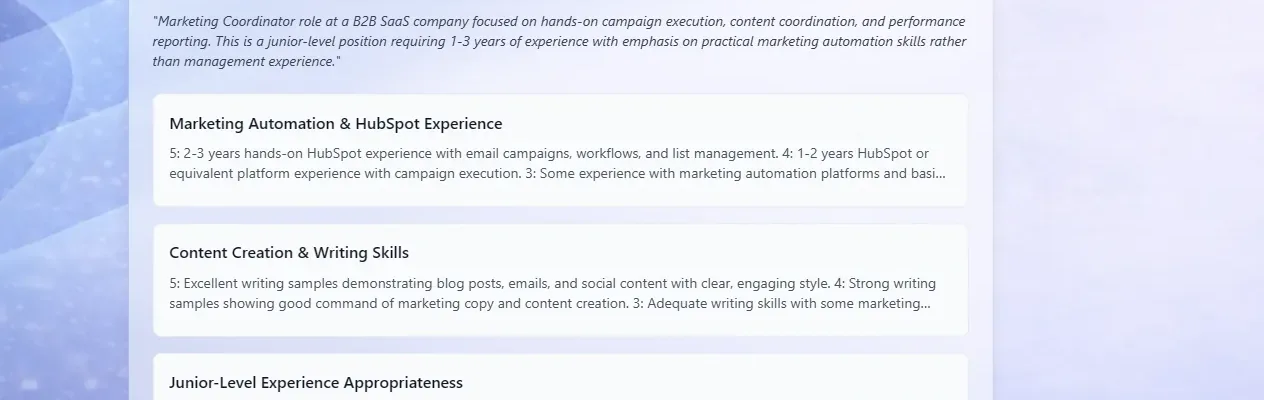
Build your screening criteria straight from the job description — free, no credit card.
5. Preferred Qualifications (Nice-to-Haves)
This is where you can expand — carefully.
Examples:
- “Experience with Kubernetes”
- “Background in fintech or SaaS”
- “Familiarity with data pipelines”
Key principle: Separate must-have from nice-to-have clearly.
Candidates often self-select out if they don’t meet every requirement — especially underrepresented groups.
6. Compensation and Benefits (Transparency Wins)
Job postings without salary ranges lose candidates.
Why:
- Candidates don’t want to waste time
- Transparency builds trust
- It improves application quality
Include:
- Salary range
- Bonus/equity (if applicable)
- Key benefits
Even a range is better than nothing.
7. Hiring Process (Set Expectations)
Most job descriptions skip this — and that’s a mistake.
Candidates want to know:
- How many stages?
- What types of interviews?
- Timeline?
Example:
“Our process includes a screening call, a technical assessment, and a final interview with the team. The process typically takes 2–3 weeks.”
Clarity reduces drop-off and improves candidate experience.
5 Mistakes That Drive Good Candidates Away
Even a decent job description can fail if it includes these common issues.
1. Unrealistic Requirements
“5+ years experience in a 2-year-old technology” is still happening.
Over-specifying requirements:
- Shrinks your candidate pool
- Filters out high-potential candidates
Fix: Focus on capability, not checklist perfection.
2. No Salary Information
This is one of the fastest ways to lose strong candidates.
Top candidates:
- Have options
- Prioritize transparency
Impact: Lower application rates and poorer fit.
3. Gendered or Biased Language
Language shapes who applies.
Research shows:
- Gender-neutral job descriptions can increase applications from women by up to 30% (Textio)
- A 2025 PNAS study (N=37,920) found replacing masculine-coded language increases female application rates
However, not all research agrees:
- MIT Sloan found gendered language has “no effects that matter in practice”
What to do: Use neutral, inclusive language — it’s a low-risk improvement.
Avoid words like:
- “Dominant”
- “Aggressive”
- “Competitive rockstar”
4. Corporate Jargon Overload
Buzzwords reduce clarity.
Examples:
- “Leverage synergies”
- “Drive strategic initiatives”
These phrases don’t tell candidates what they’ll actually do.
Fix: Use plain, specific language.
5. Walls of Text
Long, dense paragraphs reduce readability.
Remember: Candidates skim before they read.
Best practices:
- Use bullet points
- Keep sections short
- Highlight key information
3 Job Description Examples (And Why They Work)
Here are simplified job description examples you can model.
Example 1: Backend Engineer
Title: Backend Engineer (Node.js, AWS)
Why it works:
- Clear tech stack in title
- Specific responsibilities
- Focused requirements
Snippet:
You’ll design and build backend services powering our hiring platform. You’ll work closely with product and frontend teams to deliver scalable APIs.
Responsibilities:
- Build APIs using Node.js and AWS
- Optimize database performance
- Maintain system reliability
Example 2: Marketing Manager
Title: Product Marketing Manager (B2B SaaS)
Why it works:
- Clear scope (product marketing)
- Target audience defined (B2B SaaS)
- Mix of strategy + execution
Snippet:
You’ll lead go-to-market strategy for new features, working with product, sales, and growth teams.
Responsibilities:
- Develop positioning and messaging
- Launch campaigns across channels
- Analyze performance metrics
Example 3: Operations Associate
Title: Operations Associate (Logistics & Support)
Why it works:
- Accessible language
- Realistic requirements
- Clearly defined tasks
Snippet:
You’ll help manage daily operations, coordinate shipments, and support customer inquiries.
Responsibilities:
- Track deliveries and resolve issues
- Communicate with vendors
- Improve operational processes
Common traits across all examples:
- Clear titles
- Concrete responsibilities
- Structured sections
- No unnecessary fluff
How Your JD Affects AI Screening
In 2026, your job description does more than attract candidates — it shapes how they’re evaluated.
Modern hiring tools (including AI systems) rely on your JD to:
- Define evaluation criteria
- Generate screening questions
- Score candidate fit
If your JD is vague:
- AI produces weak or generic evaluation criteria
- Screening becomes inconsistent
- Strong candidates may be missed
If your JD is clear and structured:
- Evaluation criteria become precise
- Candidate assessment improves
- Screening becomes faster and more objective
This is where tools like CandidatePilot come in.
Instead of manually defining evaluation criteria, you can:
- Write your job description
- Upload it to CandidatePilot
- The AI identifies what to evaluate based on the role
Try it with your own job description — free, no credit card.
Better job description → better evaluation → better hires
Think of your JD as the foundation of your entire hiring system.
FAQ
What is the best job description template?
A simple, effective template includes:
- Job title
- Company overview
- Responsibilities
- Minimum requirements
- Preferred qualifications
- Compensation
- Hiring process
How long should a job description be?
Aim for 400–800 words. Long enough to be clear, short enough to stay readable.
Should I include salary in a job description?
Yes. It improves trust, application rates, and candidate quality.
How many requirements should I list?
Limit to 5–8 core requirements. More than that reduces applications from qualified candidates.
Do job descriptions really affect candidate quality?
Yes — significantly.
They:
- Filter who applies
- Shape candidate expectations
- Influence screening and evaluation
Given that only 4.66% of applicants meet most requirements, improving your JD is one of the highest-leverage changes you can make.
Final Takeaway
Writing an effective job posting isn’t about sounding impressive — it’s about being clear, specific, and honest.
If you improve your job description, you don’t just get more candidates.
You get better ones — and a faster path to the right hire.
Try CandidatePilot free — upload your job description, add your resumes, and get a ranked shortlist in minutes.