
Hiring your first employees—or improving how you hire—might be the most important thing you do as a small business owner. The people you bring in will shape your company’s culture, productivity, and growth trajectory more than any tool or strategy.
And yet, hiring is harder than ever. According to NFIB (Feb 2026), 85% of small business owners report receiving few or no qualified applicants, and 33% say they have roles they simply can’t fill. Even when candidates do apply, competition is intense, expectations are rising, and slow processes can cost you great hires.
Shortlist hundreds of applicants without an HR team — free, no credit card.
The good news: you don’t need a full HR team or expensive software to build a solid hiring process. With the right structure and a few practical tools, you can run a professional, effective hiring process—even if it’s your first time.
This guide walks you through the complete SMB hiring process, step by step—from defining the role to sending the offer letter.
The 7-Step SMB Hiring Process
1. Define the Role Clearly
Most hiring problems start here.
If you’re unclear about what you need, everything else—job posts, interviews, evaluations—becomes inconsistent and ineffective.
What to define before you hire:
- Core responsibilities (3–6 key tasks)
- Must-have vs. nice-to-have skills
- Seniority level (junior, mid, senior)
- Success metrics (what does “good” look like in 3–6 months?)
Common mistake:
Hiring based on a vague idea like:
“We need someone to help with marketing.”
Instead, aim for:
“We need a mid-level marketer to run paid ads and email campaigns, generating 50+ qualified leads per month.”
Quick exercise:
Write this sentence:
“This hire will be successful if they can ___ within 90 days.”
If you can’t fill that in clearly, you’re not ready to post the job yet.
2. Set Your Budget
Hiring isn’t just salary—it’s a full investment.
According to SHRM (2023), the average cost-per-hire is around $4,700. For small businesses, that can be significant.
What to include in your hiring budget:
- Salary
- Benefits (health, bonuses, etc.)
- Job board costs
- Time spent interviewing
- Tools (if any)
Market reality check:
- Nearly half of SMB hiring managers say salary expectations are their biggest challenge (Robert Half)
- In 2025, 60% of entrepreneurs increased compensation budgets by 5% or more (Inc.)
What to do:
- Research salaries using free tools (Glassdoor, Payscale)
- Benchmark against similar companies—not just big corporations
- Decide your range upfront (e.g., $45k–$60k)
Pro tip:
A realistic salary range will save you time. Underpricing leads to:
- Fewer applicants
- Lower-quality candidates
- Longer time-to-hire
3. Post the Job
Once your role and budget are clear, it’s time to attract candidates.
Where to post:
Start with:
- LinkedIn Jobs
- Indeed
- Your personal network/referrals
Optional:
- Industry-specific job boards
- Local communities or Slack groups
What makes a good job post:
- Clear title (avoid internal jargon)
- Short company intro (why you exist)
- Responsibilities (bullet points)
- Requirements (must-haves only)
- Salary range (strongly recommended)
Example structure:
- About the company
- What you’ll do
- What we’re looking for
- Compensation + benefits
- How to apply
Reality check:
Even great posts won’t guarantee strong applicants—remember:
85% of SMBs report few qualified candidates
That’s normal. Your process matters more than volume.
4. Screen Applications
This is where most small businesses get stuck.
You post a job… and suddenly:
- 50, 100, even 250+ applications arrive
- Many are unqualified
- Reviewing them manually takes hours
The bottleneck problem:
- Manual screening works for <30 applicants
- Becomes overwhelming at 50+
- Nearly impossible to do well at 100+
What to look for when screening:
- Relevant experience (not just any experience)
- Evidence of results (not just responsibilities)
- Consistency (career progression, stability)
- Basic alignment with your role
Manual vs. AI screening:
- Manual screening: fine for low volume, but slow and inconsistent
- AI screening: helps you quickly shortlist based on criteria
If you're dealing with a large applicant pool, tools like CandidatePilot (a free AI resume screening tool) can help you:
- Automatically filter applicants based on your role
- Identify top matches quickly
- Reduce hours of manual review
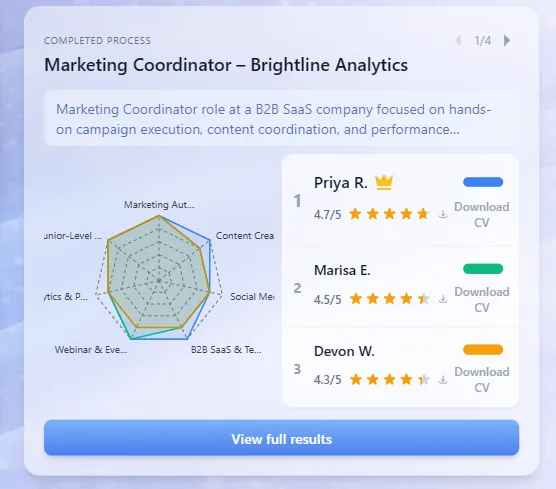
This is what the step looks like in CandidatePilot. A finished screening process for one role, with the three candidates it recommends you interview first.
Get your top candidates without reading every resume — free, no credit card.
Best practice:
- Narrow down to 5–10 strong candidates
- Don’t over-interview—focus on quality, not quantity
5. Interview Your Shortlist
Interviews are where many small businesses go wrong—not because of bad intentions, but lack of structure.
Keep it simple:
Use 2–3 rounds max:
Intro call (20–30 min)
- Basic fit, communication, expectations
Role-focused interview (45–60 min)
- Skills, past experience, problem-solving
(Optional) Final conversation
- Culture fit, alignment, questions
Use structured questions:
Instead of:
“Tell me about yourself”
Ask:
- “Tell me about a time you achieved [specific outcome]”
- “How would you approach [real problem from your business]?”
Why structure matters:
- Fairer comparisons
- Better decisions
- Less bias
What to evaluate:
- Skills (can they do the job?)
- Attitude (will they grow?)
- Communication (can they work with others?)
6. Check References
Most small businesses skip this step.
Don’t.
Why it matters:
- Validates what you’ve heard
- Reveals patterns (good or bad)
- Helps avoid costly hiring mistakes
How to do it:
Ask candidates for:
- 2–3 previous managers or colleagues
Then ask:
- “What was it like working with them?”
- “What are their strengths?”
- “Where could they improve?”
- “Would you hire them again?”
Red flags:
- Vague or overly cautious answers
- Inconsistencies with interview claims
- Hesitation to provide references
Pro tip:
Keep it short—15–20 minutes per reference is enough.
7. Make the Offer
Once you’ve found the right candidate, speed matters.
According to Robert Half:
~4 in 10 SMB hiring managers say they lose candidates due to slow hiring processes
What to include in your offer:
- Job title
- Salary
- Benefits
- Start date
- Reporting structure
- Key expectations
Verbal + written:
- Call the candidate first
- Send a formal written offer after
How to close:
- Be clear and confident
- Give a deadline (e.g., 3–5 days)
- Be ready to answer questions
Common mistake:
Taking too long to decide.
Remember:
Average time-to-hire is 42 days
But strong candidates often accept offers much faster.
Common Hiring Mistakes to Avoid
Even with a process, small mistakes can cost you great hires.
1. Hiring too fast
- Rushing leads to poor fit
- Fixing a bad hire costs more than waiting
2. Hiring too slow
- Great candidates don’t wait
- You risk losing them to faster companies
3. No structured process
- Inconsistent interviews
- Decisions based on “gut feeling”
4. Skipping reference checks
- Increases risk significantly
- You miss critical context
5. Ghosting candidates
- Damages your reputation
- Candidates talk—especially in small industries
6. Overloading requirements
- Unrealistic job descriptions reduce applicants
- Focus on what truly matters
Tools That Help (Without Breaking the Bank)
You don’t need expensive HR software to hire effectively.
Here’s a simple, low-cost stack:
| Step | Tool Type | Example | Cost |
|---|---|---|---|
| Define role | Docs/templates | Google Docs | Free |
| Salary research | Market data | Glassdoor, Payscale | Free |
| Job posting | Job boards | Indeed, LinkedIn | Free–$ |
| Screening | Resume screening | CandidatePilot | Free |
| Interviews | Video calls | Zoom, Google Meet | Free |
| References | Phone/email | — | Free |
| Offers | Templates | Google Docs | Free |
Total cost:
You can realistically run a full hiring process for $0–$200, depending on job posting options.
FAQ
How long does it take to hire an employee?
On average, about 42 days, though small businesses can move faster with a streamlined process.
How many applicants should I expect?
Anywhere from 20 to 250+, depending on the role and location.
What if I get no qualified candidates?
This is common—remember 85% of SMBs report this issue. Adjust:
- Salary range
- Job description
- Where you’re posting
Do I need HR software?
No. A simple process + a few tools is enough for most small businesses.
What’s the hardest part of hiring?
Usually:
- Finding qualified candidates
- Screening efficiently
- Competing on salary expectations
Hiring doesn’t need to be complicated—but it does need to be intentional.
If you follow a clear process, stay realistic about the market, and move quickly when you find the right person, you’ll dramatically improve your chances of making great hires—even without an HR team.
Try CandidatePilot free — upload your job description, add your resumes, and get a ranked shortlist in minutes. No ATS required.