
Eight tools will take your pile of resumes today without asking for a credit card: CandidatePilot, Rankid, Marxel, Resumes Ranker, CVscanr, Resume Screening AI, Breezy HR and Zoho Recruit — and six of the eight will rank it for you. What separates them is not the AI, it is the cap. Fifty resumes a month on one, two hundred CVs on another, forty inside a seven-day window on a third, and on two of the eight the free plan does not include AI evaluation at all. This page is for the person doing the hiring. If you are a job seeker wanting to know how your own resume scores, you are on the wrong shelf: what you want is a resume checker.
That distinction matters, because searching for "free AI resume screening" mostly returns products built for candidates polishing a single CV, not for a recruiter with a folder of sixty of them. The eight below all do the recruiter job: you give them a role and a pile, and they hand back an order.
You know the week this is for. Sixty resumes in the inbox, most from the last two days, a hiring manager who wants names before Friday, and a tooling budget of zero. Two minutes a resume is two hours you do not have, and every free tool you try costs another twenty minutes of sign-up before you find out what it caps.
Rank your pile of resumes today, free — 2 evaluations to start, no credit card, up to 400 resumes per run.
The eight free plans side by side
| Tool | Free resume cap | Jobs or runs | Users | AI ranking in the free plan | Card to start | PDF export | Languages | First paid tier |
|---|---|---|---|---|---|---|---|---|
| CandidatePilot | Up to 400 resumes per evaluation | 2 welcome evaluations | Your own account, sign-up by email code | Yes, included from the free plan | No | Yes, a downloadable PDF report | English and Spanish | US$5 for 15 evaluations, US$10 for 40, one-off packs with no subscription |
| Rankid | 50 resumes a month, refilled monthly (1 credit per resume scored) | Not published | Not published | Yes | No — "no card required" | Not published | English; we found no Spanish | US$19 one-off for 1,000 credits, and credits never expire |
| Marxel | 200 CVs a month | 1 active screening job | Not published | Yes, described as basic AI CV screening | No — "not required to start" | Not published | English, aimed at UK hiring teams | £49 a month (Starter), priced in pounds |
| Resumes Ranker | 50 resumes per job | 5 jobs, on a "$0 forever" plan | Not published | Yes | Not listed as a requirement, and not ruled out either | Not published | English; we found no Spanish | US$20 a month (Basic): 20 jobs a month, 250 resumes per job |
| CVscanr | 40 CVs, and only inside a 7-day trial | Up to 2 job postings | Not published | Yes | No — "No credit card needed" | Not published | English; Spanish not verified | US$9.90 a month billed annually (Growth): 1,000 CVs and 5 job postings a month |
| Resume Screening AI | Its own two pages publish two different figures (see below) | Not published | Not published for the free tier; Starter adds up to 3 seats | Yes | No — "no credit card" | Not published | English; Spanish not verified | US$0.07 per resume with no subscription, or Starter at US$200 a year |
| Breezy HR (Bootstrap) | Unlimited candidates | 1 active pool or position | Unlimited users | No. The free plan does resume parsing; "Breezy Intelligence" is a paid add-on on every tier, credits from US$30 per 100,000 | No — permanent free plan, plus a 14-day trial with "No Credit Card Needed" | Not published | The free plan lists "Multi-Language Support"; Spanish not verified | US$157 a month billed annually, or US$189 month to month (Startup) |
| Zoho Recruit (Free) | No resume cap published; 5,000 records in total | 1 active job | 1 user | No. AI candidate matching starts at Professional, the third tier | Not stated for the free tier; the 15-day trial and 45-day refund window are | Not published | Pages served in Spanish; currency selector for USD, INR, EUR, GBP, JPY, SGD and AUD | Not published in readable form: the page shows the unit "/recruiter/month" but the amounts load through JavaScript |
Free plans, caps and prices were read on each vendor's own pages on 9 September 2026 and can change; check before you sign up. Where a cell says a figure is not published, that is what that vendor's own pages showed on the day, not an estimate on our part. The CandidatePilot row describes our own product.
Two columns need a word. PDF export is mostly blank on purpose: none of the other seven states on its pricing page whether the free plan lets you download a report, so the honest cell is an empty one. And languages is an observed absence, not a proven one: we did not find a Spanish interface on Rankid, Marxel, Resumes Ranker, CVscanr or Resume Screening AI, which is not the same as proving there is none.
Read the unit before you read the number
"Free" here is measured in three incompatible units, and comparing headline numbers without converting them is how people end up on the wrong tool at four in the afternoon.
Per-resume credits. Rankid says it plainly: one credit per resume scored, fifty free every month. Resume Screening AI works the same way once you pay, at seven cents a resume. The only question in this unit is how many documents you have.
Per-job caps. Resumes Ranker gives five jobs of fifty resumes each; Marxel gives 200 CVs a month but one active screening job; CVscanr gives 40 CVs across two postings, for seven days. Here a single pile can be too big even when your monthly total is fine.
Per-process runs. CandidatePilot counts evaluations rather than documents: two to start, each run holding up to 400 resumes. Sixty resumes and four hundred resumes cost the same thing, which is one run.
Sixty resumes for one role, today, on the free plan. It fits a single CandidatePilot run with 340 to spare, and Marxel's monthly allowance with 140 left. It does not fit Rankid's fifty free credits, so you wait for next month's refill or buy the US$19 bundle. It does not fit one Resumes Ranker job, since each caps at fifty, so the pile splits across two of your five jobs and the ranking splits with it. It does not fit CVscanr's forty-CV trial at all. On Breezy HR and on Zoho Recruit's free tier the sixty are welcome, but nothing will rank them.
If handing a whole pile to a tool is new to you, how AI resume screening actually works covers what these products do to a stack of PDFs before any order appears.
The eight tools, one by one
CandidatePilot
Free: 2 welcome evaluations, no card, no subscription. Each takes a job description as a PDF and up to 400 resumes, and returns a ranked list with a written reason per candidate, a recommended top three, an interview guide per finalist and a downloadable PDF report. Sign-up is an emailed code; the interface exists in English and Spanish.
Caps: runs, not their size. Two to start is plenty for one role and not enough to open a vacancy a day. Packs are one-off: US$5 for 15 evaluations, US$10 for 40.
Best for: one role, a deadline, and a hiring manager who will not log into anything. It is the filter you use today for this vacancy, not an applicant tracking system.
Rankid
Free: fifty credits every month, refilled automatically, "no card required", at one credit per resume scored — so fifty resumes a month. Paid top-ups are one-off bundles, not a subscription: US$19 for 1,000 credits, which never expire.
Caps: documents. Fifty a month is a comfortable trickle and an uncomfortable single role. In free volume it beats us outright, and that is worth saying plainly rather than dressing up.
Best for: a steady drip of applications rather than one flood, and anyone who wants pay-per-use with nothing recurring attached.
Marxel
Free: the most generous permanent allowance here — "GBP 0 forever", 200 CVs a month, one active screening job, card "not required to start". Its AI sorts candidates into named groups, Aligned, Potential, Hold and Unclear, with reasoning attached.
Caps: concurrency, and it prices in another currency. One live screening job means a second vacancy waits its turn, and paid tiers are quoted in pounds — £49 a month for Starter, £149 for Pro — so convert before comparing.
Best for: UK hiring teams, which is who it says it is built for, running one vacancy at a time with real monthly volume.
Resumes Ranker
Free: a permanent "$0 forever" plan with five jobs and fifty resumes inside each. A card is not listed as a requirement, though the page does not rule one out either.
Caps: the pile per job, which is the cap most likely to bite. Five jobs sounds roomy until one vacancy brings eighty applications and you have to split them to get them all read. Basic, US$20 a month, raises it to 250 resumes per job across 20 jobs a month.
Best for: several small vacancies at once, a few dozen applicants each, rather than one role with a long tail.
CVscanr
Free: a seven-day trial with up to 40 CVs and two job postings, no card, no auto-renewal, cancel any time. It is the one entry here that is honestly a trial rather than a free plan, and its own page says so.
Caps: the clock, before anything else. When the week ends there is no free tier underneath, and the entry plan, Growth at US$9.90 a month, is billed annually — the cheap headline arrives with a year attached.
Best for: evaluating a paid tool properly on a small test pile. Wrong pick if you needed something permanently free.
Resume Screening AI
Free: something, without a card, but the site publishes two different figures for it. Its pricing page states, verbatim: "71 free screenings to start — no credit card" (resumescreening.ai/pricing). Its home page describes the free start differently, as up to five resumes at a time. The two pages disagree, neither explains the other, and we could not reconcile them on 9 September 2026 — treat both numbers as unconfirmed until you see your own balance.
Caps: unclear while free, and priced per document above it: US$0.07 per resume with no subscription, or Starter at US$200 a year. At seven cents each, a sixty-resume role costs about US$4.20 once the free allowance is gone.
Best for: a technical user who wants pay-as-you-go with no plan; its home page even offers to use your own model key.
Breezy HR (Bootstrap)
Free: a lot, permanently. Unlimited users, unlimited candidates, a branded careers page, distribution to job boards and resume parsing, with one hard limit: one active pool or position at a time. There is also a full-feature 14-day trial with "No Credit Card Needed".
Caps: the part you came here for. Parsing extracts data from a resume; it does not evaluate or rank one. Breezy's AI evaluation, "Breezy Intelligence", is a paid add-on on every tier including the expensive ones, credits from US$30 per 100,000. Paid plans start at US$157 a month billed annually, or US$189 month to month.
Best for: a team that wants somewhere free to receive and organize applications for one open role. If the reading is what you needed help with, this free plan does not do it.
Zoho Recruit (Free)
Free: a real permanent tier at US$0 with one active job, one user, 5,000 records and 256 MB, plus a 15-day trial and a 45-day refund window on the paid plans. Its pages are served in Spanish, which none of the smaller tools here offered.
Caps: active jobs rather than resumes, and, crucially, the AI. Candidate matching starts at Professional, the third tier, so neither the free plan nor the entry paid plan includes it. The paid prices we could not read at all: the page shows the unit "/recruiter/month" with the amounts injected by JavaScript, so there is no figure to quote.
Best for: a company already standardized on Zoho that needs somewhere to park one vacancy. If you are weighing this class of product seriously, our buyer's guide to screening software for small teams compares the subscriptions rather than the free tiers.
What the result looks like
A free plan is easier to judge from what comes out of it than from a feature list. The example below comes from a Marketing Coordinator role with 30 applicants; sixty or three hundred looks the same.
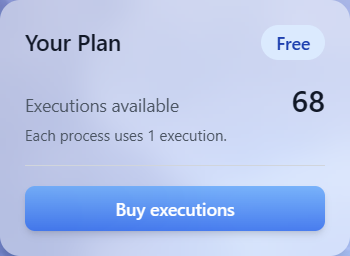
Start with what every comparison table abstracts away: your remaining allowance, visible before you commit a pile to it. Knowing you have a run left is the difference between screening today and hitting a cap halfway through.
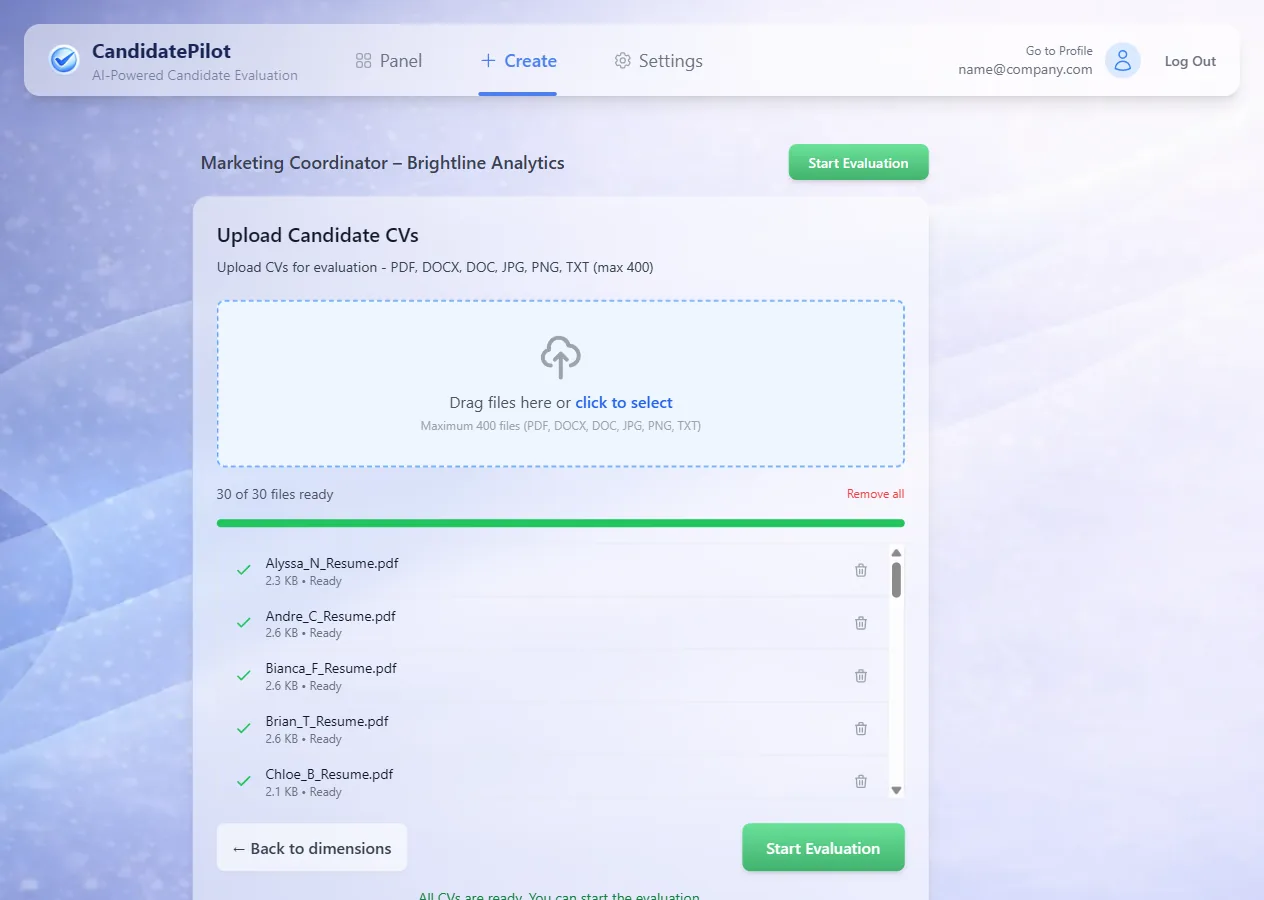
Then the pile goes up in one go rather than one file at a time, which is where most of the saved afternoon comes from. Watch the file counter, not the clock: the run carries on without you and emails you when it is finished.
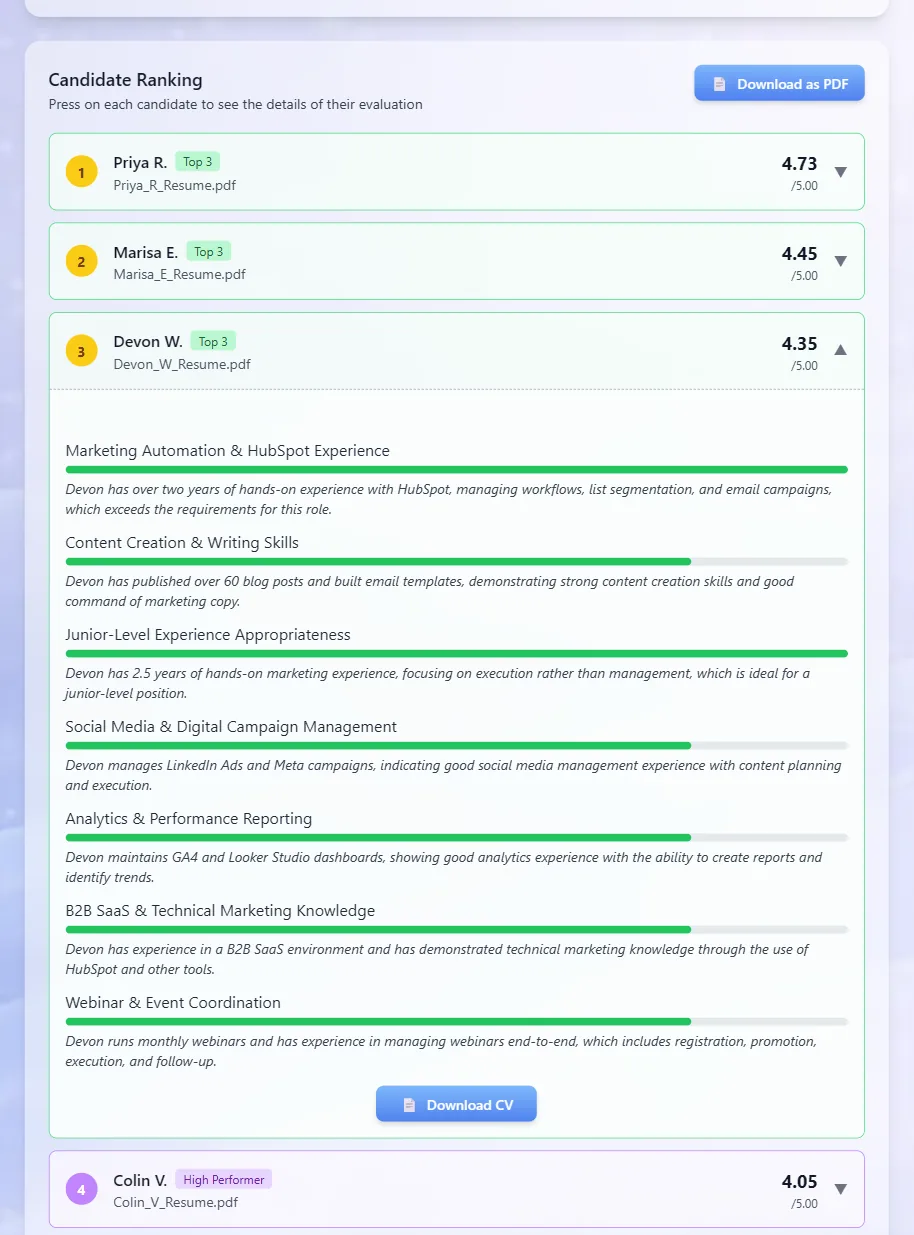
And this is the output that matters — everyone in order, and you can open any candidate to see why they scored the way they did, so you can work down from the top and sanity-check the tool on two or three names near the middle. For the whole sequence step by step, our walkthrough of shortlisting 100 CVs with AI follows one role from job description to shortlist.
Try it on the pile you have open right now — free, no credit card, and a 60-resume role fits inside a single run.
Two habits that make a free run worth more
These matter more on a free plan than on a paid one, because you get fewer chances to get it right.
Name the seniority in the posting. Every screening tool reads experience as strength, so the applicant with twelve years and a head-of-department title tops the list for an assistant role — and then turns the offer down. One line in the job description, or in the field for aspects the posting does not cover ("this is a junior role; do not favor profiles with 8+ years or management titles"), visibly reorders the free run around people who would actually take the job.
Formatting costs good candidates places. A CV with no dates, job titles hidden inside a graphic, or a scan with no text layer comes out below its real level, and that is as true of a tired human at 6pm as of a tool. Ask for plain PDFs with clear dates and titles when you publish the role, and before closing the process open the two or three lowest-ranked files to check none of them is a good candidate with a bad template. Our 15-point resume screening checklist is a useful second pass over whatever order you end up with.
Frequently asked questions
Is free AI resume screening accurate?
Accurate enough to put a pile in a sensible order; not accurate enough to hire from without reading anything. The practical test is whether each position arrives with a written reason you can check in ten seconds. Read the reasons rather than the documents, and open two or three names in the middle of the list — if you disagree with the tool there, you have usually learned something about your job description rather than about the AI. The final call stays yours, free plan or paid.
Do I need a credit card for free AI resume screening?
Mostly not, and this is one of the few places where the category behaves well. CandidatePilot, Rankid, Marxel, CVscanr and Resume Screening AI all state on their own pages that no card is needed to start, and Breezy HR says the same of both its permanent free plan and its 14-day trial. Resumes Ranker and Zoho Recruit do not list a card as a requirement on their free tiers, but they do not say it in so many words either, so treat those two as unconfirmed rather than as a yes.
How many resumes can I screen for free?
It depends entirely on the unit being counted. CandidatePilot: 2 evaluations to start, each holding up to 400 resumes. Rankid: 50 resumes a month. Marxel: 200 CVs a month on one active job. Resumes Ranker: 5 jobs of 50 resumes each. CVscanr: 40 CVs, and only inside a 7-day trial. Breezy HR and Zoho Recruit take unlimited candidates and 5,000 records respectively, but neither will rank them on its free tier.
Is it safe to upload candidate resumes to a free tool?
Resumes are personal data about other people, so the bar is higher than for your own files, whichever tool you pick. In CandidatePilot, the files you upload are processed to produce your evaluation, and the results belong to your account. Beyond that, this is not something a comparison post should invent on a vendor's behalf: read that vendor's own privacy and data terms before you upload a client's pile, and if you recruit under GDPR or an equivalent regime, check that what you are about to do matches what you told candidates when they applied.
What is the difference between free resume screening and a free ATS?
They solve different halves of the problem, and this is where most free-tool searches go wrong. A free ATS gives you somewhere to receive, store and organize applications: Breezy HR's Bootstrap plan and Zoho Recruit's free tier both do that, and both cap you at one active job. What neither does for free is read the pile — Breezy parses resumes without evaluating them, and Zoho's AI matching starts two tiers up. A free screening tool does the opposite: it ranks the pile, explains the order and gets out of the way. Free ATS means free storage; free screening means free reading. Hire continuously for long enough and you will want both, and our small-team buyer's guide covers where that line sits.
The short version
No free plan here is best in the abstract; they fit different shapes of week. For a steady trickle of applications, Rankid's fifty monthly credits and Marxel's two hundred CVs are the most generous allowances in the list, and neither asks for a card. For one role that suddenly produced sixty or two hundred resumes, the per-run unit wins, because the whole pile fits inside a single free evaluation instead of being rationed by credits or split across job slots. And two of the eight, Breezy HR and Zoho Recruit, are free places to collect resumes rather than free ways to read them. Check the unit, check whether the AI is included at all, check what you can hand the hiring manager afterwards, and start with the tool whose cap is bigger than your pile.
Try CandidatePilot free — upload your job description, add your resumes, and get a ranked shortlist in minutes.