
If you have 80 resumes for one role and nobody whose actual job is hiring, you are choosing between two different products and only one of them fits today. A screening tool reads the pile, ranks it and explains the order for this role, once, and you can pay for it by the process. An applicant tracking system runs hiring as an ongoing operation, with a careers page, pipeline stages, candidate emails and reporting, and it bills you every month whether or not a role is open. Below are six tools priced against both jobs, every figure checked on 9 September 2026.
The posting went up on Monday, by Thursday there were 80 applications, the hiring manager wants three names before next week's meeting, and two minutes per resume is more than five hours you do not have. Every hour spent comparing vendors is an hour not spent on the pile.
Upload your job description and your resumes and get a ranked shortlist — free, no credit card, up to 400 resumes per process.
Two purchases that look like one
Almost every "best candidate screening software" list mixes two purchases that behave nothing alike, which is why the prices in them look absurd next to each other. Sorting your own situation into one of the two takes about thirty seconds and saves you the rest of the research.
"I have 80 resumes for one role." You post a job every few months. There is no careers page to maintain, no pipeline to keep warm, nobody chasing a hiring metric. What you need is a filter: something that takes the job description and the pile, returns an ordered shortlist with a reason attached to each name, and produces something you can forward to the person who will run the interviews. When the role closes, you want the spending to stop. A subscription priced per seat per month is the wrong shape for that, because you are buying twelve months of software to solve four days of work. This is the situation CandidatePilot is built for, and the boundary is worth stating plainly: it is not an ATS and it does not try to replace one. It is the filter you use today, for this role.
"I hire continuously and need a pipeline." You have three or four roles open at any time, candidates who applied in March that you want to revisit in September, a hiring manager who wants to see stages, and enough volume that "where did that candidate's email go" is a real cost. Now a monthly subscription earns its keep, and the tools to look at are Workable, Breezy HR, Manatal, Zoho Recruit or Recruit CRM. Our comparison of how the enterprise-grade hiring platforms differ from a screening tool covers the top of that market, and the ATS guide for startups covers it by company stage.
Plenty of small teams end up doing both: an ATS for the roles that stay open, and a screening pass for the one role that unexpectedly produced 80 applications. If you have never run a screening pass before, how AI resume screening actually works and five faster ways to get through a stack of resumes are the two useful background reads.
The six tools at a glance
| Tool | Free plan | Entry price (currency / unit) | Pay per use or subscription | Minimum commitment | AI screening included? | Languages / markets | Resume limit |
|---|---|---|---|---|---|---|---|
| CandidatePilot | Yes, permanent: 2 welcome evaluations, no credit card | US$5 for 15 evaluations, US$10 for 40 (one-off packs) | Pay per use | None; there is no subscription to cancel | Yes, included from the free plan | English and Spanish; global | Up to 400 resumes per process |
| Workable | No free plan. 15-day trial with the complete Standard feature set, no credit card | US$299 / month (Standard; the page also shows US$3,588 / year) | Subscription, per company, priced by employee band | No published minimum term, and no per-job purchase any more | No. The AI recruiting agent is a credit add-on: 3,000 free credits per plan, then from US$0.12 per credit (US$600 for 5,000) | English site, prices in USD | No published resume cap; "unlimited active jobs", subject to fair usage limits |
| Breezy HR | Yes, permanent "Bootstrap" plan: unlimited users and candidates, 1 active position. Plus a 14-day full-feature trial, no credit card | US$157 / month billed annually, or US$189 / month billed monthly (Startup) | Subscription, flat per company rather than per seat | None published; you can pay month to month | No. "Breezy Intelligence" is an optional add-on on every tier, credits from US$30 per 100,000. The free plan includes resume parsing, not evaluation | Not verified; the free plan lists "Multi-Language Support" | Unlimited candidates on every plan; the cap is active jobs (1 on the free plan) |
| Manatal | No free plan. 14-day trial, no credit card | US$15 / user / month billed annually, or US$19 / user / month billed monthly (Professional) | Subscription, per seat | Month-to-month is available; the US$15 rate requires the annual term | Yes. Automatic candidate recommendations from the job description and AI candidate scoring, in all paid plans | Site offers a Spanish language selector; global | 15 jobs and 10,000 candidates on Professional |
| Zoho Recruit | Yes, permanent free tier at US$0: 1 active job, 1 user, 5,000 records. Plus a 15-day trial and a 45-day refund window | Not published in readable form. The page shows the unit ("/recruiter/month") but the amounts load through JavaScript and did not render | Subscription, per recruiter per month, monthly or annual | Billed per recruiter; the page does not show which price is monthly and which is annual | Partly. AI candidate matching starts at the third tier (Professional); the free and Standard tiers do not include it | Pages served in Spanish; currency selector for USD, INR, EUR, GBP, JPY, SGD, AUD | No published resume cap; the cap is active jobs: 1 free, 100 Standard, 250 Professional, 750 Enterprise |
| Recruit CRM | A free trial is mentioned, but neither its length nor whether a card is required is published | Does not publish a price. Three plans (Pro, Business, Enterprise) and a monthly/annual toggle, with no figures on the pricing page, the FAQ or the help center | Subscription, per seat | Monthly billing and cancel-anytime are documented; the seat minimum is not published | Partly. Resume parsing, a generative-AI integration and AI sourcing on all plans, but a parser extracts data rather than ranking it; "Candidate Matching" is capped at 2 matches on the entry plan and 50 above it | Not verified | Record caps per user: 10,000 (Pro), 20,000 (Business), 30,000 (Enterprise); unlimited jobs |
Prices and plans checked on each vendor's own pricing pages on 9 September 2026; they can change. Where a cell says a vendor does not publish a price, that is what its own pages showed that day, not an estimate on our part. The CandidatePilot row describes our own product.
Read the unit before you read the number. Five of the six rows above are priced per seat or per company, per month, indefinitely. CandidatePilot is priced per process: US$10 buys 40 process runs, and each run can carry up to 400 resumes. Those are not the same unit, so the honest arithmetic is per role, not per month. One month of Workable Standard is US$299 for one company. One month of a single Manatal seat is US$19, already almost twice the price of a pack that covers 40 separate roles. One month of Breezy Startup billed monthly is US$189. None of that makes the subscriptions bad products. It makes them the wrong shape for someone hiring one person this quarter.
Six things to check before you pay
1. Is AI screening included, or is it a separate bill? This is the question the category buries, and for a small team it is the whole decision. On Workable, the AI recruiting agent that sources, screens and qualifies candidates is an add-on that runs on credits: each plan comes with 3,000 free credits, and after that packs start at US$0.12 per credit, or US$600 for 5,000. On Breezy HR, "Breezy Intelligence" is an optional add-on on every tier, including the paid ones, with credits from US$30 per 100,000. In other words, the two best-known small-business ATS platforms sell you a hiring workflow, and the actual reading of resumes is a second purchase. Zoho Recruit puts AI candidate matching on the third tier. Recruit CRM caps matching at two candidates on its entry plan. Only Manatal includes real candidate scoring in all of its paid plans, and only CandidatePilot includes it in a free one.
2. Are you paying per use or per seat, per month? A per-seat subscription assumes hiring is a permanent activity with a permanent owner. If your last hire was in March and your next one is in January, you will pay for ten months of nothing. Pay-per-use pricing has the opposite failure mode: it gets expensive if you genuinely hire every week. Match the pricing shape to your hiring rhythm rather than to the feature list.
3. Can you start without a credit card? More vendors clear this bar than you would expect, and it is fair to say so: Workable's 15-day trial and Manatal's 14-day trial both state that no card is required, Breezy HR and Zoho Recruit both keep permanent free tiers, and CandidatePilot's free plan gives you 2 evaluations to start without one. Recruit CRM mentions a trial but does not publish its length or whether a card is needed. If your budget for this role is zero, our roundup of free AI resume screening tools and what each one caps goes through the free tiers in detail, including the ones that are trials wearing a free-plan label.
4. Can you hand the hiring manager something? In a small team the person who reads the resumes is rarely the person who decides. Whatever you buy has to end in an artifact you can send: a PDF, an email, something that survives being forwarded. A ranking that lives only inside a dashboard your CEO will not log into is a ranking that gets re-litigated from scratch in a meeting.
5. Does the result explain itself? Any tool can produce an order. What makes an order usable is a short, checkable reason for each position, so that when a founder asks "why is this person above that one", the answer is on screen instead of being "the software said so". Explainability is also your only practical defense against silently discarding a good candidate, which is a real risk when the tool is doing the reading.
6. What happens when the role closes? Ask this before you sign up, not after. With a one-off pack there is nothing to cancel and unused runs simply wait for the next role. With a subscription, you own a monthly cost until you remember to cancel it, and with an annual term you own it for the year. None of the six vendors here publishes a compulsory minimum term, although Manatal's US$15 rate and Breezy's US$157 rate both require taking the annual plan, and Recruit CRM does not publish a seat minimum at all. The point is simpler than the small print: a monthly subscription that requires an action to stop is not the same product as a purchase that stops by default.
The six tools, one by one
CandidatePilot
The filter, not the system. You upload the job description as a PDF and up to 400 resumes per process, and you get back a ranked list with an explanation for each candidate, a recommended top three, a suggested interview guide per finalist, a visual comparison of the finalists and a downloadable PDF report. It works in English and Spanish. There is no careers page, no pipeline, no candidate email templates, and no attempt to be an ATS: when this role is filled, you close the tab.
Pricing is the part that differs most from everything else in this guide: a free plan with 2 welcome evaluations and no credit card, then one-off packs of US$5 for 15 evaluations or US$10 for 40, with no subscription and no minimum term. Sign-up is by email code, so there is no password to invent. Best for: one role, a pile of resumes, a deadline, no HR department. Not for you if: you need to track candidates across stages for months.
Workable
The default answer for small businesses that hire continuously, and the reason so many buyer's guides quote a high entry price. As of 9 September 2026 its pricing page shows three subscription plans only, starting at Standard for US$299 per month (also displayed as US$3,588 per year), with Premier and Enterprise above it. Two things worth correcting if you read an older comparison: there is no Starter plan and no pay-per-job option any more, so a single-role purchase is not available; and the AI screening is not part of the subscription, but a credit-based add-on as described above. The 15-day trial is genuinely generous — the complete Standard feature set, no credit card — so if you want to test a full hiring workflow for free for two weeks, this is the cleanest way to do it. Best for: a company hiring several roles at once that wants one system for everything. Not for you if: your total hiring for the year is one person.
Breezy HR
The most generous permanent free plan in this group. The "Bootstrap" tier gives you unlimited users, unlimited candidates, a branded careers page, distribution to job boards and resume parsing, with one hard limit: one active position at a time. For a small team that hires one role every few months, that limit may never bite, which makes Breezy the free option worth taking seriously if what you want is a place to receive applications. The catch is the same one that runs through this guide: parsing is data extraction, not evaluation. The free plan will collect and organize your 80 resumes; it will not tell you which eight to interview, because "Breezy Intelligence" is a paid add-on at every tier. Paid plans start at Startup, US$157 per month billed annually or US$189 billed monthly, flat per company rather than per seat. Best for: free applicant collection with a careers page. Not for you if: the reading is the part you needed help with.
Manatal
The cheapest verified way to get a real ATS that also scores candidates. Professional is US$15 per user per month billed annually, or US$19 billed monthly, and unlike Workable and Breezy, AI candidate recommendations and automatic candidate scoring are included in all paid plans rather than sold as credits. Professional covers up to 15 jobs and 10,000 candidates, there is a 14-day trial with no credit card, and the site offers a Spanish language selector. It is a per-seat subscription rather than a per-process purchase, so the comparison is not about capability but about shape: one seat for one month costs almost twice a pack that covers 40 separate roles. Best for: a recruiter or small agency hiring continuously who wants scoring without an add-on bill. Not for you if: you want to pay once and stop.
Zoho Recruit
The other real free tier, and the one most likely to already be inside a company that uses other Zoho products. Free means US$0 for one active job, one user and 5,000 records, plus a 15-day trial and a 45-day refund window on paid plans. The limits are worth reading in the right unit: the cap is active jobs, not resumes — 1 on Free, 100 on Standard, 250 on Professional, 750 on Enterprise. Two caveats for a small team. First, AI candidate matching starts at Professional, the third tier, so the free plan and the entry paid plan do not include it. Second, we could not read the actual prices: the page displays the unit "/recruiter/month" but the amounts are injected by JavaScript and did not render, so we are not going to guess at them. Best for: teams already standardized on Zoho. Not for you if: you need AI evaluation on the cheapest tier.
Recruit CRM
Built for staffing agencies rather than for a company hiring its own people, and priced accordingly — which is to say, not priced publicly. Four separate checks on its own pages, including the pricing page, the FAQ and the help center, produced no per-seat figure at all. What is documented is the mechanics: three plans (Pro, Business, Enterprise), monthly or annual billing, cancel any time, record caps of 10,000 to 30,000 per user, and unlimited jobs. Its AI is worth unbundling too: resume parsing, a generative-AI integration and AI sourcing appear on all plans, but parsing extracts data rather than ranking it, and "Candidate Matching", the feature closest to a ranking, is limited to two matches on the entry plan. For a small team without a procurement process, "request a quote" is usually a reason to look elsewhere first. Best for: agencies managing client requisitions. Not for you if: you want to know the price before you talk to someone.
What the result looks like
A screening pass is easier to judge from its output than from a feature list, so here is what comes out the other end of one. The example below is a Marketing Coordinator role with 30 applicants; the shape is identical at 80 or 300.
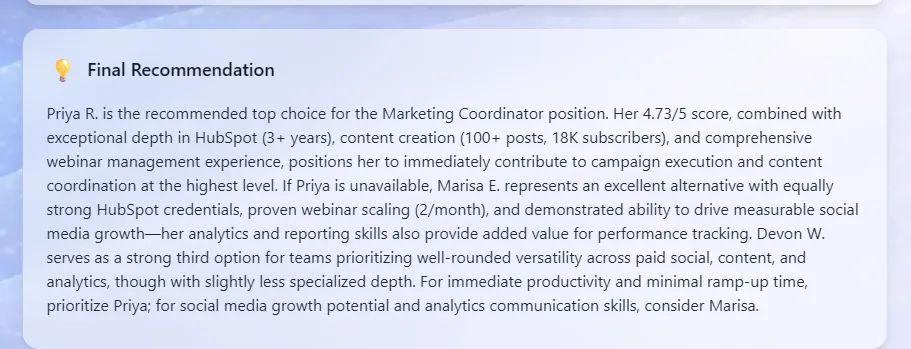
The first thing to look at is the recommendation: three names, in order, each with the reason it is there and what to check in the interview. This is the part you forward to the hiring manager, and the part that decides whether the tool saved you an argument or created one.
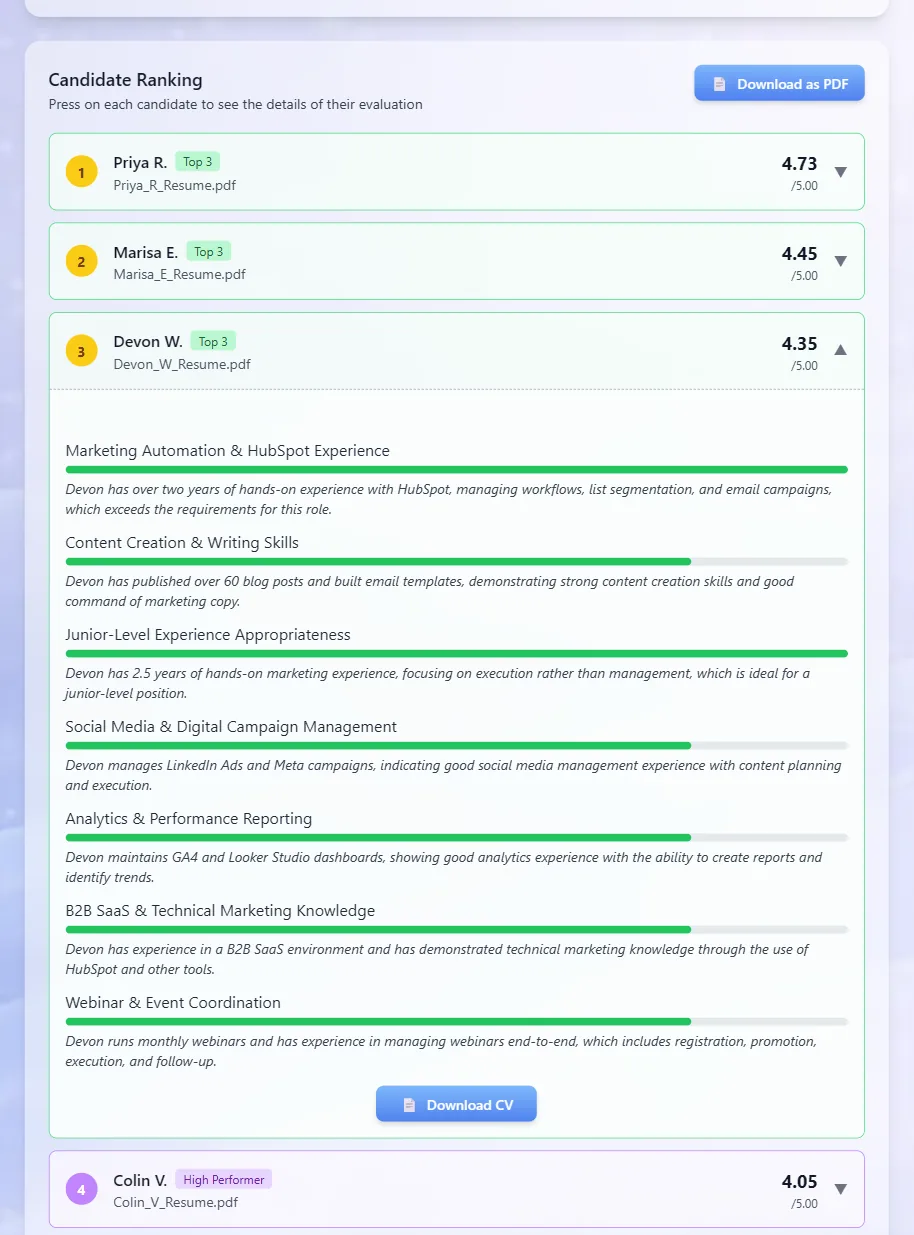
Below the finalists sits the rest of the field, in order. This view matters more than it looks: open any candidate to see why they scored the way they did, then sanity-check the tool by comparing two or three names near the middle. If you agree with the tool, you have just replaced five hours of reading. If you do not, you have learned something about your job description in ten minutes.
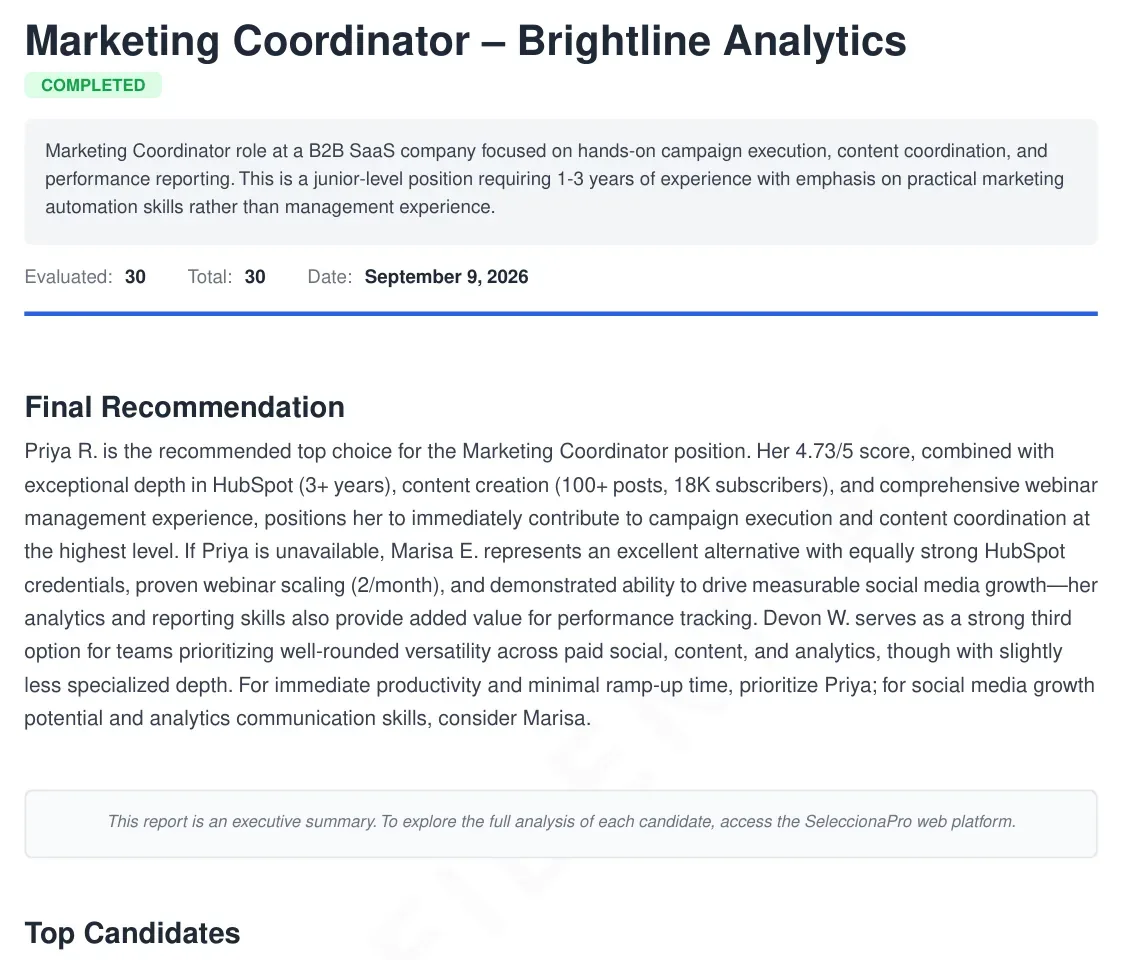
And this is the artifact from criterion four: a PDF you can download and send, with the summary, the recommendation and the detail behind it, so the decision travels without anyone needing an account. If you would rather see the whole sequence step by step, our walkthrough of shortlisting 100 CVs with AI follows one role from job description to shortlist.
Run your first shortlist free — 2 evaluations to start, no credit card, no subscription.
Two things that make your ranking better
These two come from running real roles, and they apply whichever tool you end up using.
Say out loud that the role is junior. Left to itself, any screening tool reads seniority as strength, and the overqualified candidate with twelve years and a head-of-department title lands at the top of a list for an assistant role. Writing one line in the job description, or in the optional field for aspects not covered by the posting — "this is a junior role; do not favor profiles with 8+ years or management titles" — pushes those profiles down where they belong and lifts the candidates who would actually accept the job. It is the single highest-return sentence you can add.
Badly formatted resumes get judged badly. A resume with no dates, no clear job titles and everything in one block is hard for a tool to read and tends to land below its real level. Two defenses: ask candidates for a PDF with clear dates and titles when you publish the role, and before you close the process, open the two or three lowest-ranked resumes and check that none of them is a good candidate with a bad template. It takes three minutes and it is the cheapest insurance in the process.
When you do need an ATS
There is a point where the per-role filter stops being the right purchase, and it is worth naming so you do not underbuy either. Move to an applicant tracking system when two or more roles are open at the same time, when you find yourself wanting to reopen a candidate from a previous search, when more than one person needs to see where each candidate stands, when candidates are complaining that nobody replied, or when someone starts asking for hiring metrics. At that point you are managing a process, not filtering a pile, and a pipeline, a careers page and shared candidate history are worth a monthly fee.
If that is your situation, start with the free tiers rather than the US$299 one: Breezy HR's Bootstrap plan and Zoho Recruit's free plan both cover a single active job at no cost, and Manatal is the cheapest verified path to an ATS that also scores candidates. Our guide to choosing an ATS by startup stage breaks that decision down by how many people you hire per year. And the two purchases are not exclusive: plenty of teams keep an ATS for the pipeline and run a screening pass on the one role that produced 200 applications.
Frequently asked questions
What is candidate screening software? Software that reads incoming resumes against a role and tells you which ones deserve an interview. Some products do only that, and are bought per role. Others fold it into a full applicant tracking system with a careers page and a pipeline, and are bought per seat per month. The terms candidate screening tool, candidate screening platform and candidate resume tool are used interchangeably in this market, so read the pricing page rather than the label.
Is there free candidate screening software? Yes. CandidatePilot gives you 2 welcome evaluations with no credit card and no subscription. Breezy HR and Zoho Recruit also have permanent free plans, but both cap you at one active job, and neither includes AI evaluation in its free tier — Breezy's free plan does resume parsing, and Zoho's AI matching starts at its third tier. More options are compared in our roundup of free AI resume screening tools.
What is the difference between screening, shortlisting and ranking? Screening is deciding who is out. Ranking is putting the rest in order. Shortlisting is picking the handful you will actually interview, usually three to eight names. They are three stages of the same afternoon, and a good tool does them in one pass and explains the order it produced.
Does candidate screening software replace an ATS? No, and be suspicious of anyone who says otherwise. An ATS manages the whole hiring workflow: careers page, pipeline stages, candidate communication, history, reporting. A screening tool handles one role's pile of resumes and then gets out of the way. Many small teams run on a screening tool for years before an ATS is worth paying for.
Does it work with CVs as well as resumes? Yes. CV and resume are the same document under different names depending on where you hire, and the same is true of "curriculum vitae" in India, the UK and the Gulf. Upload them as PDFs either way; what matters is that they are readable files, not scans of photographs.
How many resumes can I screen at once? In CandidatePilot, up to 400 per process, which covers almost any small-team role — most land between 40 and 150. The other five tools in this guide do not publish a resume cap at all; their limits are on active jobs (1 on the free tiers of Breezy HR and Zoho Recruit) or on stored records per user.
What is the best resume screening method for a startup? The one you will actually finish this week. In practice that means: write the requirements down before you read anything, run the whole pile through one tool in a single pass so that everybody is judged by the same yardstick, check a few names in the middle of the ranking by hand, and interview five or six rather than fifteen. Five faster ways to screen resumes covers the manual versions of the same idea.
The short version
If you have one role, a pile of resumes and no HR department, you are not in the market for an applicant tracking system yet — you are in the market for an afternoon back. The six tools above split cleanly along that line: Workable, Breezy HR, Manatal, Zoho Recruit and Recruit CRM sell you a hiring operation by the month, and in most of them the AI that actually reads the resumes is a separate purchase, a higher tier or a two-match sample. A per-process filter sells you the reading itself, once, for this role, and stops when you stop. Check the unit, check whether the AI is included, check that the result explains itself and can be forwarded as a PDF, and buy the shape that matches how often you hire.
Try CandidatePilot free — upload your job description, add your resumes, and get a ranked shortlist in minutes.